
How to Start Seeds Indoors
Starting seeds indoors gives slow-maturing crops the head start they need in climates with short growing seasons. Count backward from your last expected frost date: peppers and eggplant need 8–10 weeks indoors, tomatoes 6–8 weeks, cucumbers and squash only 2–3 weeks. Start too early and you get rootbound, stressed transplants that often perform worse than on-schedule ones.
How it works
The tricky part is replicating what seeds need — warmth, consistent moisture, and adequate light — without creating conditions that invite disease. Most failures trace to three mistakes: wrong timing, insufficient light, and soggy growing medium.
Garden soil has no place in seed-starting containers. It weighs roughly 75 lbs per cubic foot versus about 10 lbs per cubic foot for a soilless mix, compacts under repeated watering, and can carry pathogens. Use a commercial soilless seed-starting mix — sphagnum peat moss, perlite, and vermiculite — or mix your own: 10 gallons shredded peat moss, 10 gallons vermiculite, 1¼ cups dolomitic limestone, ½ cup superphosphate, and 1 cup 5-10-10 fertilizer (Rutgers NJAES). That germination mix still needs supplemental feeding beginning about 3 weeks after seeding.
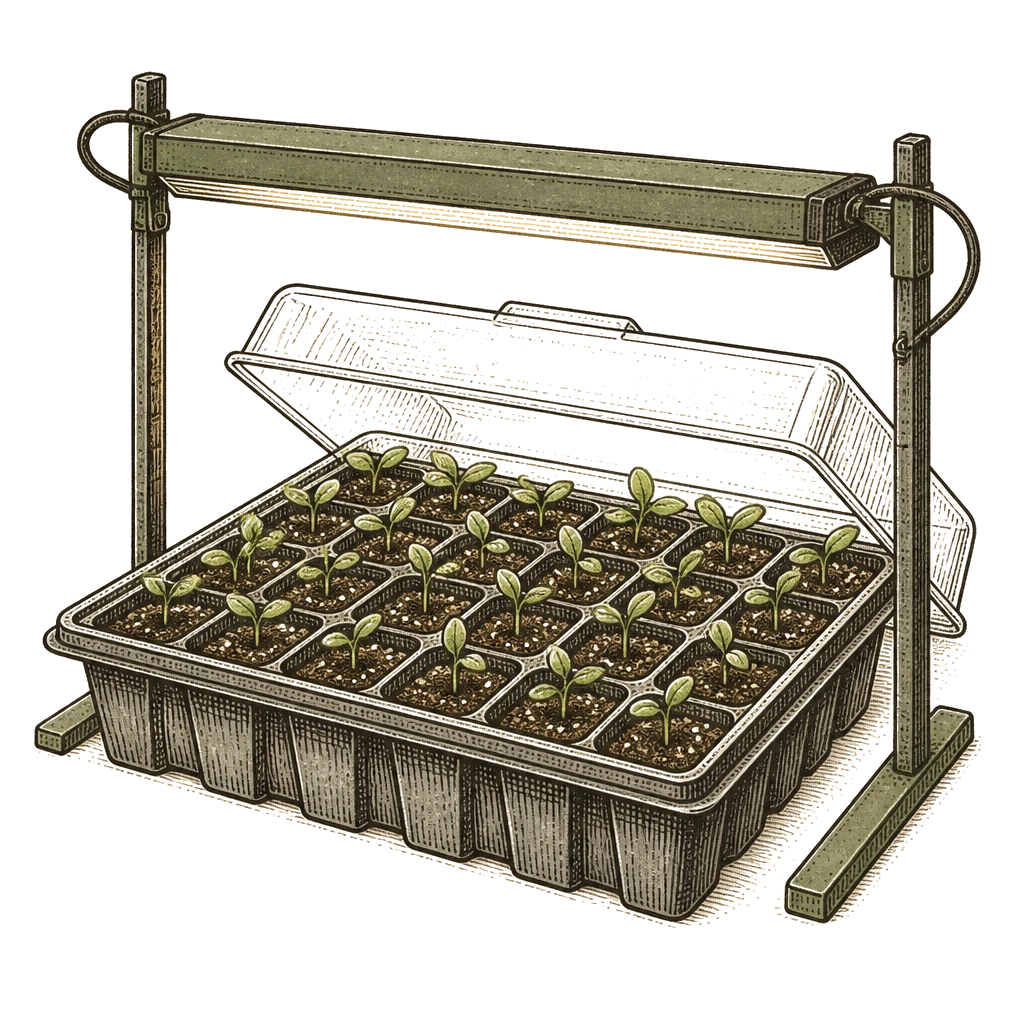
A south-facing window alone is not enough in northern climates in early spring. Most windows deliver far fewer than the 14–16 hours of adequate light intensity seedlings require. Without supplemental grow lights, seedlings stretch toward whatever light they can reach — an “etiolated” growth habit that produces weak, spindly transplants. Fluorescent or LED shop lights work; keep them 2–4 inches above the seedling tops and raise the fixture as plants grow.
What to do
Containers. Any clean container with drainage holes works — plastic cell packs, peat pots, recycled yogurt cups. Minimum depth is 2 inches. Cell size matters for root development: lettuce and greens need 3–6 square inches per cell; broccoli, cabbage, cucumbers, and squash need 4–9 square inches; tomatoes, peppers, and eggplant need 9–16 square inches. Reused containers must be scrubbed in soapy water, then soaked in a 1-part bleach to 9-parts water solution for 30 minutes before use. Skipping this step is the single most reliable way to import damping off.
Sowing. Fill containers with moistened soilless mix to about ½ inch from the rim. Sow 2–3 seeds per cell — you’ll thin to one after germination. Thin once seedlings show their first true leaves, snipping the weaker ones off at soil level with scissors rather than pulling, which disturbs the roots of the seedling you’re keeping. Planting depth is roughly twice the seed’s diameter: onions, peppers, and tomatoes go ¼ inch deep; broccoli, cabbage, cauliflower, cucumbers, melons, and squash go ½ inch deep. Cover flats with a plastic dome or plastic wrap to hold moisture, and remove it the moment seedlings emerge.
Warmth. Most vegetable seeds germinate best between 65–75°F soil temperature, but crop-specific optimums run higher: beans, broccoli, and cabbage do best at 80°F; eggplant, peppers, and tomatoes at 85°F; cucumbers, melons, and squash at 90°F. Containers can run 5°F cooler than the ambient air temperature, so a heating mat under the flat closes that gap without heating the whole room.
Light. Once seeds germinate, run lights 14–16 hours per day. Keep bulbs 2–4 inches above seedling tops — closer at first, raising the fixture as seedlings grow. After potting up to a larger container, University of Maryland Extension recommends dropping to 1–2 inches above the canopy until plants are established.
Watering. Bottom-watering is the cleanest technique: fill the tray under the containers with 1–2 inches of water and let it absorb for 3–10 minutes, then drain any standing water. Use warm water — around 68–77°F — on young seedlings. Cold water at 50°F slows growth and raises the risk of fungal infection. Keep the mix consistently moist but never waterlogged; soggy conditions invite damping off.
Fertilizing. Soilless mixes contain no nutrients on their own. Begin feeding when the first true leaves appear, using a soluble fertilizer at ¼ strength every other watering. (The Rutgers DIY mix above carries its own starter charge, but still needs supplemental feeding by about 3 weeks after seeding.)
Potting up. Move seedlings into larger containers 2–3 weeks after germination, before roots circle the bottom of the cell.
Airflow. Begin running a small fan near your seedlings when they develop two true leaves. Gentle air movement strengthens stems and dries any moisture that would otherwise linger on foliage.
Hardening off. Before transplanting, harden seedlings off over 1–2 weeks: set them in a shaded, sheltered spot outdoors for a few hours the first day, bring them back in before sundown, and gradually increase their sun and outdoor time until they’re ready to plant.
Log your seed-start date in Arbor and it schedules the potting-up reminder and the transplant window automatically, counting both forward from that date.
Zone and season notes
All timing is relative to your local last frost date, not a fixed calendar date. Illinois Extension provides a useful illustration: central Illinois’s last frost falls around early May; southern Illinois gardeners start 2 weeks earlier, northern Illinois gardeners 2 weeks later. Find your average last frost date from a university extension service for your county or region.
Onions, leeks, and celery are the earliest starts anywhere in the country — 10–12 weeks before last frost. Peppers need 8–10 weeks; eggplant, 8–9 weeks. Brassicas (broccoli, cabbage, cauliflower) need 5–7 weeks. Tomatoes, 6–8 weeks. Cucumbers, melons, and squash: 2–3 weeks only. The short window for cucurbits is not a shortcut — it prevents rootbound transplants that stall badly after planting.
Cool-season crops can also be started in early July for a fall garden. In most temperate zones, broccoli, cabbage, and lettuce started indoors in midsummer will be ready to transplant about 3–4 weeks later, landing in the garden when summer heat begins to ease.
In warm-winter zones (9–11), the last frost date may be in January or may not apply at all. Gardeners in those zones often start heat-loving crops in late winter for spring planting and start cool-season crops in late summer for fall and winter harvest.
Sources
- University of Minnesota Extension — Starting Seeds Indoors
- Clemson HGIC — Starting Seeds Indoors
- Rutgers NJAES — FS787: Starting Vegetable Seeds Indoors
- University of Maryland Extension — Starting Seeds Indoors
- University of Minnesota Extension — How to Prevent Seedling Damping Off
- NC State Extension — Damping-Off in Flower and Vegetable Seedlings
- Wisconsin Horticulture / UW-Extension — Seed Starting
- Illinois Extension — When Should I Start My Seeds?