
How to Grow Okra: Planting, Fertilizing, Harvest
Okra’s whole season runs on one habit: picking pods before they mature. A pod left on the plant goes woody and slows the next round of pods, so harvest is upkeep. Wait to sow until soil reaches 65°F at a 4-inch depth, measured with a soil thermometer. Thin plants to about 18 inches in the row, and feed at planting plus twice more once plants are 6 to 8 inches tall. First pods arrive 50 to 60 days after transplanting, 60 to 70 days from direct-sown seed. After that, cut every other day in hot weather, daily at the peak, or two to three times a week where summers are milder, for up to twelve weeks.
How it works
Leave a pod to mature and the plant holds back the ones behind it, trimming the season’s total. Pods run from open flower to harvest size, 2 to 4 inches long, in one to three days, so “not ready” becomes “past ready” fast. Every other day covers most of the season; in the hottest stretch, when a pod can make that trip in a single day, walk the row daily. A plant cut regularly keeps flowering; one carrying even a few overgrown pods starts shutting down.
Temperature governs the rest: germination runs best in soil between 70°F and 95°F, and plants grow best in air between 75°F and 90°F. 65°F at a 4-inch depth is the floor; 70°F and up is where germination runs fast and even, so a gardener who can wait a week should. In a cold-winter climate that lands about two weeks after the last frost, mid- to late May in central Iowa.
What to do
Sowing and spacing
- Soak seed in water for several hours or overnight to improve germination.
- Sow 1 inch deep, 4 to 6 inches apart in the row.
- Thin seedlings, once they’re a few inches tall, to about 18 inches apart, with 36 inches between rows.
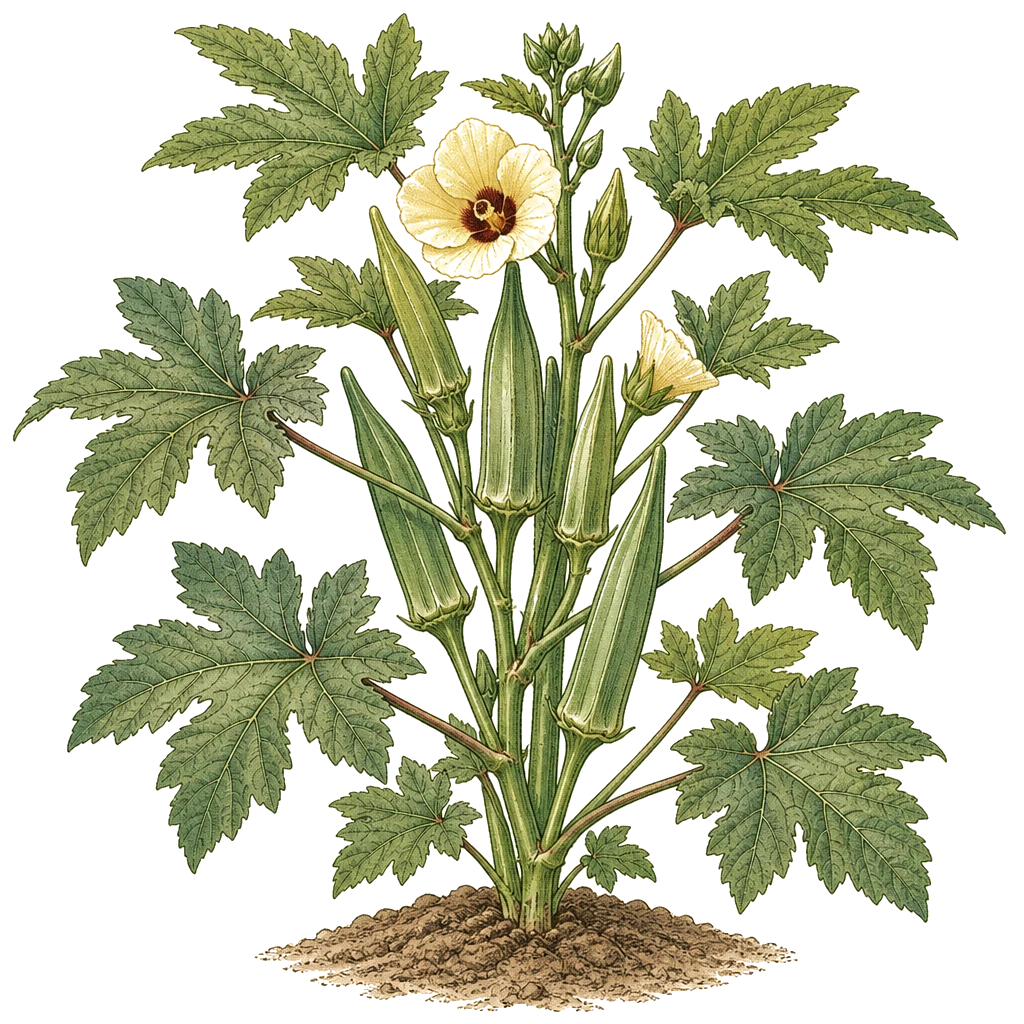
In-row spacing runs from 9 inches to 2 feet, with 36 to 48 inches between rows. Give tall varieties the roomy end: 18 inches. ‘Clemson Spineless’, ‘Annie Oakley II’, and ‘Cajun Delight’ reach 4 to 5 feet with dark green, spineless pods, while ‘Burgundy’ is an open-pollinated, burgundy-podded variety closer to 4 feet. Direct sowing into warm soil is the simplest route. For a jump on the season, start seed indoors 6 to 8 weeks before the outdoor planting date. Okra wants the same long, hot window as sweet potatoes, so the two slot into the season together.
Soil, water, and fertilizer
Give okra full sun and fertile, well-drained soil, and skip low spots. Sandy loam high in organic matter is best, though okra grows on all soil types. Water deeply and evenly to keep soil moisture uniform, and water in the morning so foliage dries before dark.
Nitrogen timing is what people get wrong, in both directions. Heavy nitrogen before the plants start fruiting buys tall, leafy growth and few pods. Once pods are setting, the reverse holds: okra needs nitrogen coming steadily to keep a long pod set going, through the late stretch when blooms have climbed to the top of the plant.
Work a balanced granular fertilizer into the bed before planting: 10-10-10 means equal parts nitrogen, phosphorus, and potassium. About 10 ounces covers a 4x8 bed (2 pounds per 100 square feet). Go heavier, 13 to 26 ounces, if the bed has never had a soil test (25 to 50 pounds per 1,000 square feet). Then side-dress twice: scatter fertilizer alongside the row, a few inches out from the stems. That’s about a quarter ounce of 10-10-10 per 8 feet of row (3 ounces per 100 feet), applied first when plants are 6 to 8 inches tall and again two to three weeks later. Calcium nitrate is the other side-dress, nitrogen only, at about 1.3 to 2.6 ounces per 8 feet of row, timed 3 to 4 weeks and 6 to 8 weeks after planting.
Cutting pods
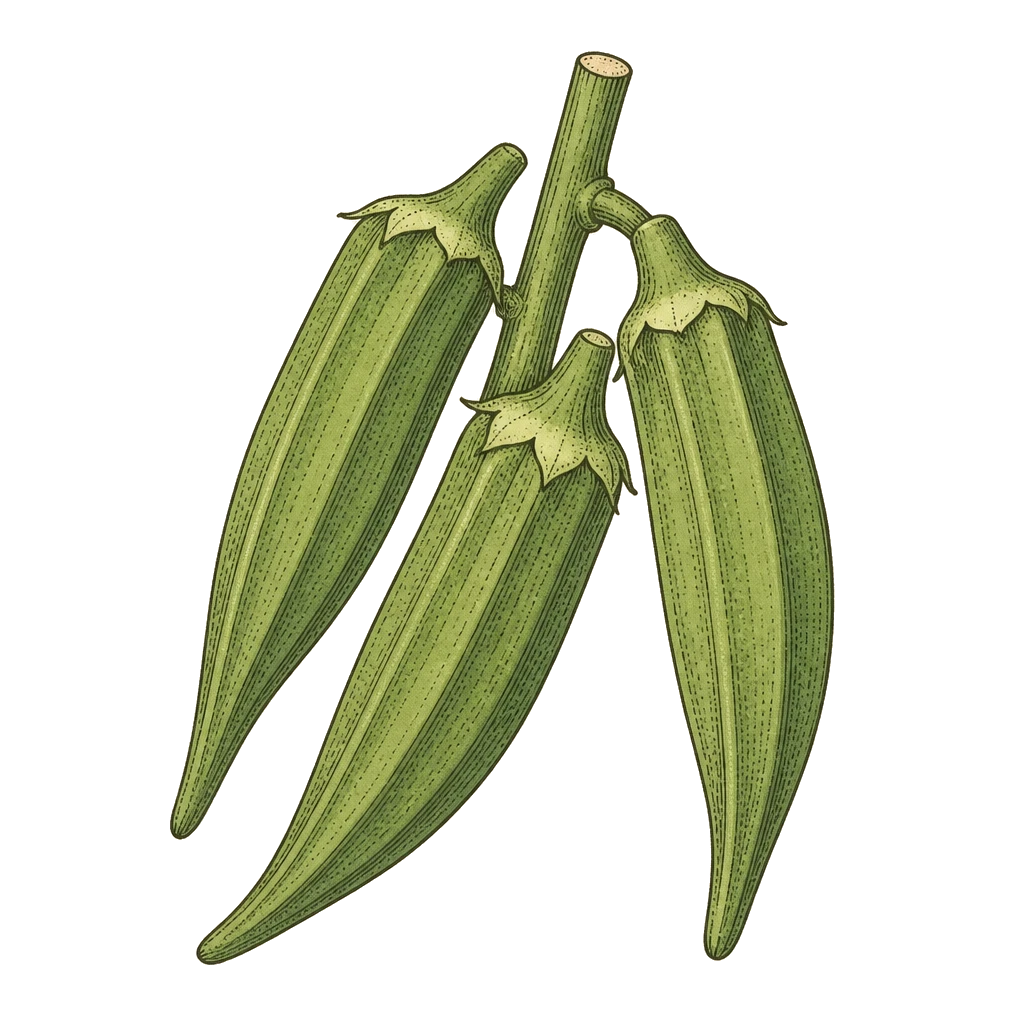
Okra pods are cut, not snapped, so use clippers or a knife. Older varieties carry spines on stems and pods, so wear gloves; spineless types make that optional without changing the technique. Harvest at 2 to 4 inches, one to three days after the flower opens. First pods come 50 to 60 days after transplanting, or 60 to 70 days from seed sown straight into the ground, not a transplant already weeks old. Log the first harvest date in Arbor and it keeps a recurring pick task on your list. For general technique, see how to harvest vegetables.
When production slows
If production slows in midsummer, strip and discard oversized pods first and get back on schedule — clearing over-mature pods is what keeps plants blooming. For plants that don’t respond, ratooning buys a second run of pods. In South Carolina that means cutting plants back to 6 to 12 inches above the soil line, between mid-July and mid-August. Feed again with a bag whose potassium number is about double its nitrogen (4-0-8, 5-0-10, 10-0-20), at 2.5 to 4 ounces per 8 feet of row or 2 to 3 pounds per 100 feet. Then water frequently through the heat that follows. Pod production typically resumes in 4 to 6 weeks and runs until first frost.
Zone and season notes
Soil temperature sets the planting date. In a cold-winter zone like central Iowa, 65°F soil lands roughly two weeks after the last frost, mid- to late May; in warmer zones that threshold arrives earlier and the direct-sow window opens sooner. Harvest frequency scales with heat the same way: at 75°F to 90°F, pods size up fast enough to need picking at least every other day, while a cooler-summer garden can hold to three times a week without losing pods to overmaturity.
Whether ratooning is worth doing comes down to your frost date. The cutback window falls mid-July to mid-August and needs 4 to 6 weeks of regrowth plus a real picking run before first frost closes things out, so it only pays off where the frost date is still that far away. In a short-season zone the frost date arrives before that math works, and a gardener there is better served by an early, well-timed first planting.
While scouting the row for ready pods, watch for pest damage too. Corn earworm occasionally bores into pods, and curled pods or wart-like protrusions point to stink bug or leaffooted bug feeding, both running up to 3/4 inch long. Melon aphid, a little over 1/16 inch and yellow to green depending on the season, turns up on okra the same way it does on other vegetables; see aphids on vegetables for treatment.
Sources
- University of Maryland Extension — Growing Okra in a Home Garden
- Clemson Cooperative Extension HGIC — How to Grow Okra in South Carolina
- University of Georgia Extension — Home Garden Okra (C941)
- Iowa State University Extension — Growing Okra in the Home Garden
- NC State Extension Publications — Pests of Okra
- N.C. Cooperative Extension (Union County Center) — Growing Okra in the Home Garden