
Spider Mites on Vegetables: Spot Them Early
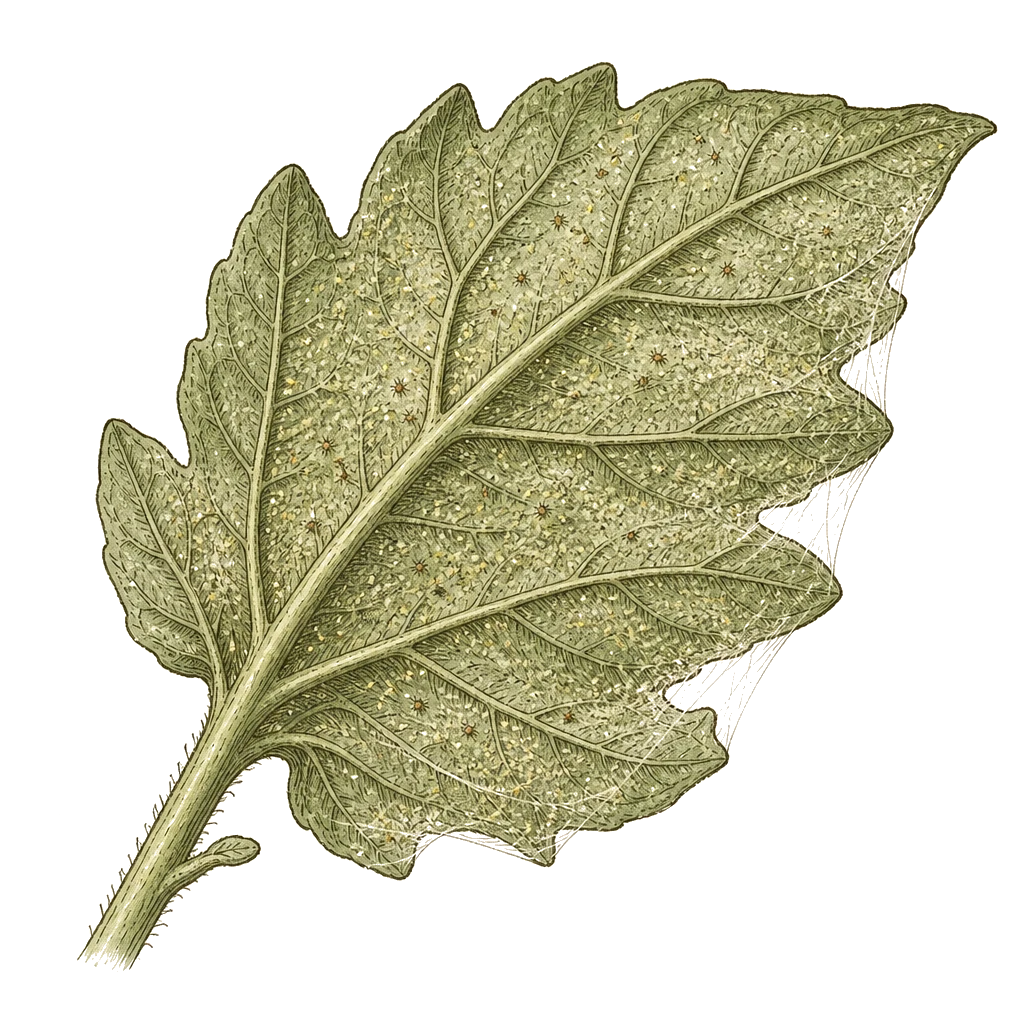
If your bean, tomato, or squash leaves are developing fine white stippling and a dull, bronzed look — especially during a hot, dry stretch — flip a leaf over and look for tiny moving dots and fine silk webbing. That’s spider mites. The first move is a hard spray of water aimed at the undersides of leaves, repeated every few days. The longer fix is making sure your plants aren’t drought-stressed, because water stress is the condition spider mites exploit, and adequate irrigation is the single best prevention.
What’s actually happening
Spider mites aren’t insects — they’re arachnids, same class as spiders and ticks, with eight legs and a body under 1/20 inch long, smaller than a period. The twospotted spider mite (Tetranychus urticae) is the species you’ll nearly always be dealing with in a vegetable garden. They live in colonies on leaf undersides, sucking chlorophyll out of individual cells, and produce the fine silk webbing that gives them their name.
UC IPM describes the damage pattern: light stippling first, then yellowing or bronzing, then leaf drop. On squash, melons, and watermelons, that leaf loss directly reduces fruit size and quality. Beans and peas are among the other host crops.
The reason outbreaks seem to arrive fully formed is speed. UC IPM’s cucurbit guidelines note that a generation can complete in as few as 5 to 7 days in midsummer heat. A small colony on a single leaf in week one is a plant-wide infestation by week three.
Three conditions drive outbreaks, and they all point the same direction: hot weather, dry soil, and dust. UC IPM notes that mites prefer hot, dusty conditions and that water-stressed plants are the most likely to be damaged.
What to do
First, confirm they’re there. Mites are hard to see with the naked eye. Illinois Extension suggests shaking suspect leaves over white paper; mites show up as tiny crawling dots.
If mites are active, spray leaf undersides hard with the hose, repeating every few days. This disrupts colonies and knocks mites off, and it’s genuinely effective for moderate infestations. At the same time, fix the conditions they love: water adequately (UC IPM lists proper irrigation as an important cultural control) and mulch to keep dust down. Maryland Extension adds that mites overwinter in nearby weeds and migrate in, so suppressing weeds at the garden margins cuts off the supply line.
For heavy infestations, move to insecticidal soap or horticultural oil (petroleum-based, or plant-based like neem or canola). These kill on contact, so thorough coverage of leaf undersides is the whole game — spray the tops and you’ve accomplished nothing. Two cautions from UC IPM: don’t apply above 90°F or to drought-stressed plants, since both can burn foliage. Because soap has no lasting residual, plan to reapply — Oregon State recommends a repeat 2 to 3 days later to catch newly hatched mites. Logging that first spray in Arbor sets up the follow-up spray tasks and tracks the dates for you, so the reapplication doesn’t slip.
What not to do: reach for a pyrethroid or organophosphate. UC IPM is unusually direct here — broad-spectrum insecticides are not very effective against mites and frequently cause outbreaks by killing predatory mites, lacewings, and minute pirate bugs. Oregon State notes that a diverse garden with perennial plantings sustains predatory mite populations year-round — which is why the predators are the long game, working only if you don’t spray them out.
When to worry and when not to
Light stippling on a few leaves of an established tomato, especially with active predatory mites present: monitor. Webbing spreading across multiple plants, bronzed leaves dropping, fruit exposed: treat now. On squash and melons, heavy defoliation reduces fruit size and quality even if the plant survives.
Zone and season notes
Spider mites are the most climate-predictable pest in a vegetable garden. Where it’s hot, dry, and dusty, they show up; where it’s cool, wet, or humid, they mostly don’t.
In hot inland climates (zones 9–11, the arid interior West, and hot dry stretches anywhere), mites are a predictable mid-to-late-summer pest. On annual vegetables, the yield damage tends to be done before predators catch up.
In cold-winter zones, a hard freeze kills most overwintering mites outdoors — Oregon State confirms cold winters are an effective natural reset. Populations start low in spring and build through summer, so outbreaks tend to arrive later, peaking in July and August rather than June. UC IPM notes mites overwinter as mated females under bark scales and in ground litter, re-emerging when warm weather returns. The same hot, dry, dusty conditions drive outbreaks here too — Illinois Extension names midsummer heat waves as the Midwest trigger.
In humid climates with regular summer rain, outbreaks are least common. Moisture is the mite’s enemy: rain dislodges them, and humidity slows reproduction. But even in the Southeast or Mid-Atlantic, a two-week dry spell in July can produce a localized flare on water-stressed plants near dusty edges.
Sources
- UC Statewide IPM Program — Spider Mites (Pest Notes)
- University of Maryland Extension — Spider Mites on Vegetables
- Oregon State University Extension — How to Recognize and Manage Spider Mites in the Home Garden
- Illinois Extension — Managing Spider Mites in the Garden and at Home
- UC Statewide IPM Program — Spider Mites / Cucurbits (Agriculture: Pest Management Guidelines)