
Whiteflies on Vegetables: What Actually Works
Most vegetable-garden whitefly problems arrive on transplants from the greenhouse, which means the most effective control happens at the garden center, before you buy anything. Tap the leaves of tomato, eggplant, and cucumber starts; if a cloud of tiny white insects lifts off, put the tray back. For an infestation already in the ground, the treatment that holds up is insecticidal soap, a contact spray that kills only what it directly wets. Cover the leaf undersides, and plan on spraying more than once. A stronger spray won’t do better — even the most toxic insecticides are only partially effective against whiteflies, and they destroy the natural enemies that were doing most of the work.
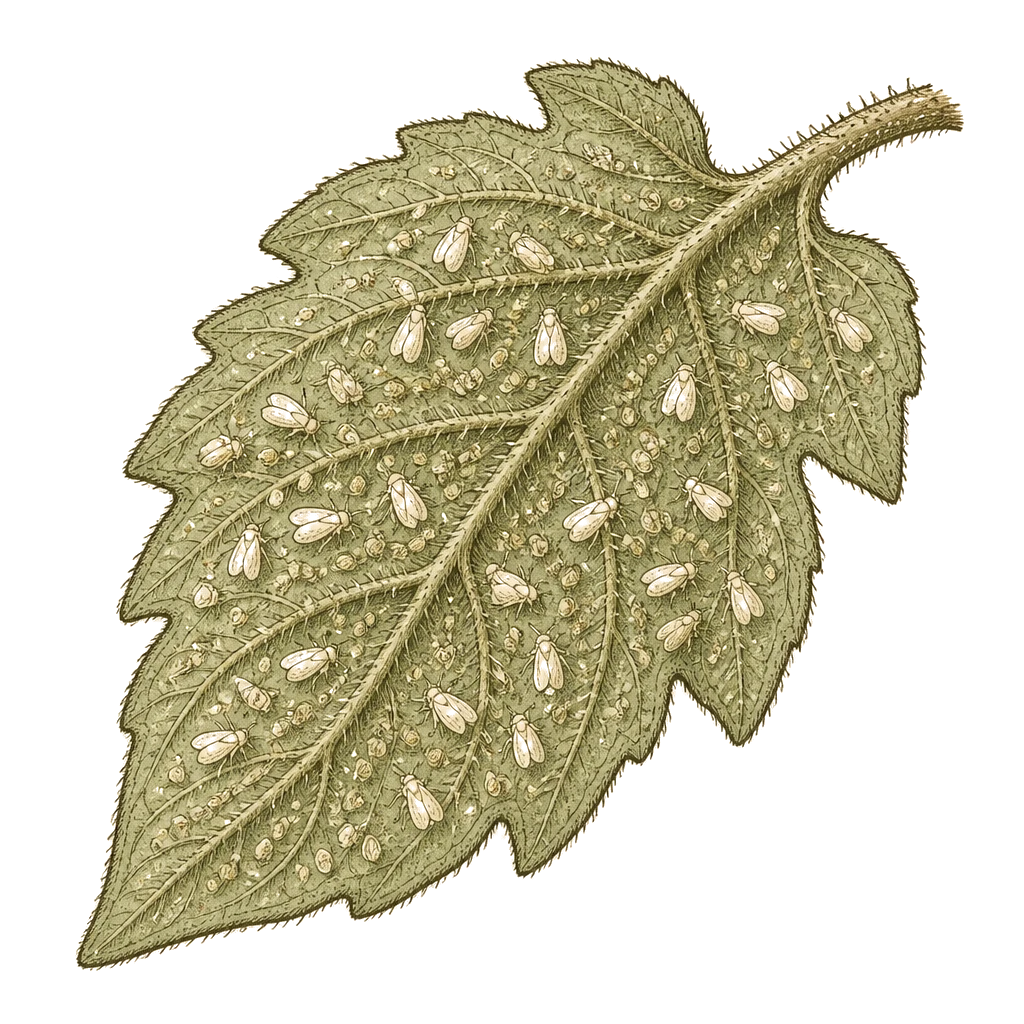
What’s actually happening
Whiteflies aren’t true flies. They’re tiny sap-sucking insects related to aphids and scales, about 1/10 to 1/16 inch long, with powdery white wings. The two species that matter in vegetable gardens are the greenhouse whitefly (Trialeurodes vaporariorum) and the sweetpotato whitefly (Bemisia tabaci). As a group, whiteflies feed on more than 250 kinds of plants — beans, cucumbers, eggplant, lettuce, tomatoes, squash, cabbage-family crops, and more.
Adults and nymphs (the legless immature stage that settles and stays put) cluster on leaf undersides and feed by piercing cells and sucking sap. The damage runs a predictable arc: stippling first, a fine pale speckling where cells have been drained, then yellowing, then leaf distortion and drop. Heavy infestations wilt and stunt plants. Like aphids, whiteflies excrete honeydew, and the black sooty mold that grows on it isn’t a plant infection and washes off produce — but heavy coverage blocks light from the leaf, which reduces photosynthesis and weakens the plant.
The deeper concern is virus transmission. The sweetpotato whitefly alone vectors 111 plant viruses by Colorado State’s count, and the largest group of those, the begomoviruses, can cost an infected tomato crop anywhere from a fifth of its yield to all of it. Which species you have doesn’t change the plan: everything below works on both. The virus risk does change the urgency, though. Spread between plants tracks population density, so the time to act is while numbers are low.
Two things make whiteflies frustrating once established. They reproduce fast: females lay 200 to 400 eggs each, and generations overlap through the summer. And management is genuinely difficult once populations are high — prevention and early intervention are what move the numbers, while a rescue spray on a heavy infestation is mostly buying time.
What to do
Prevention starts at the garden center. Inspect every transplant: tap the leaves and watch for flights before you buy. Whiteflies that hitchhike from a greenhouse skip all the natural-enemy pressure that would normally suppress them outdoors.
If you catch an early infestation, prune out the infested leaves — the flat, scale-like nymphs on the undersides are inconspicuous but do most of the damage. A strong jet of water knocks adults off and thins the egg-layers, which buys a little time before you treat, though it does nothing to the nymphs already anchored under the leaves.
Yellow sticky traps won’t eliminate an infestation, but comparing catches week to week tells you whether numbers are rising or falling. You may need as many as one trap for every two large plants, with the sticky panel level with the infestation.
Reflective silver or aluminum mulch repels whitefly adults, and it earns its keep most while plants are small enough to leave bare ground showing. Pull it once they have grown enough to cover most of it, or sooner if summer temperatures climb — reflective mulch left down in the heat overheats the plants it was protecting.
When physical controls aren’t enough, spray insecticidal soap or neem oil on leaf undersides, mixing at the rate on the product label. Coverage matters more than the product you pick, and neither leaves a residual that keeps working after it dries. Keep brushing the leaves in the days after a spray; as long as adults still lift off, spray again. That repetition is where most home whitefly control falls apart; a single spray feels decisive and accomplishes almost nothing. If you log a whitefly problem in Arbor, it prompts you to add repeat spray tasks and tracks what you used and whether it worked, so next season you’re not guessing at what to reach for.
The instinct to escalate to a stronger spray is wrong here. UC’s statewide pest-management program puts it plainly: broad-spectrum insecticides — pyrethroids, organophosphates, and neonicotinoids — kill the lacewings, lady beetles, and parasitoid wasps that suppress whitefly populations naturally. Check the active-ingredient line on anything already in your shed against those three classes. Whiteflies rebound; their predators don’t. The strong spray makes the next outbreak worse than the current one.
When to worry and when not to
A few adults fluttering when you brush a leaf: the parasitoid wasps are probably already working. Parasitized nymphs turn dark and look like pepper specks, so turn over a few leaves and look before you reach for anything. Heavy nymph loads on leaf undersides, visible honeydew, sooty mold: act now, because virus transmission risk climbs with population density.
Zone and season notes
Whiteflies are tropical and subtropical insects, which is what makes zone the deciding factor here: they do best where it stays warm enough to reproduce continuously. In frost-free climates with no hard winter, they breed year-round with no die-off, moving host to host as crops are pulled. Gardens that run continuously need continuous scouting.
In cold-winter zones, outdoor populations have traditionally died each winter and persisted only indoors or in greenhouses, so the annual re-introduction comes almost entirely via greenhouse transplants in spring. That makes the transplant-inspection step the single most valuable control where winters are cold: starts that come home clean often mean a season without them. That northern line is moving, though — whiteflies now overwinter in central Maryland, especially where late-season leafy greens grow under protective plastic and fabric covers through fall and winter.