
Tomato Hornworms: How to Find and Remove Them
If something is stripping your tomato plant down to bare stems, it’s almost certainly a hornworm. Pick it off by hand and drop it in a bucket of soapy water. UMN Extension calls handpicking the most effective management for home gardens. A few minutes of scouting twice a week genuinely solves this one.
What’s actually happening
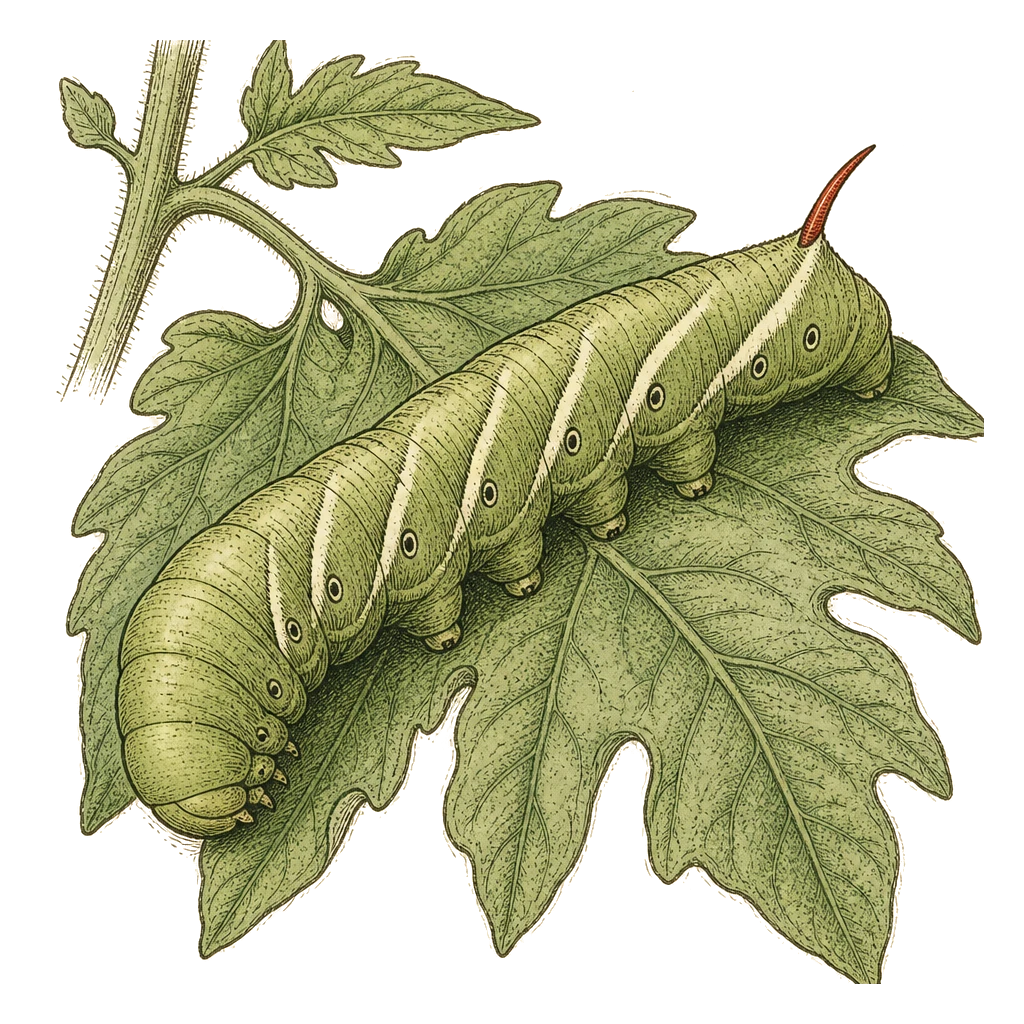
Hornworms are caterpillars of the sphinx moth, and they’re enormous — up to 4 inches long, bright green, with white stripes and a harmless horn on the rear end. Two species feed on tomatoes: the tobacco hornworm (Manduca sexta) and the tomato hornworm (Manduca quinquemaculata). The names are confusing because the tobacco hornworm feeds on tomatoes too, so both turn up on the same plants. Tell them apart by the horn — red for tobacco, blue-black for tomato, per NC State Extension — but it doesn’t matter for control.
The damage seems sudden because of how they eat. UC IPM’s tomato guidelines note that larvae feed for 3 to 4 weeks, and UGA Extension puts roughly 90% of total foliage consumption in the last instar. A caterpillar that was easy to miss on Monday can be a defoliator by Thursday. They’ll also feed on other nightshade-family crops.
What to do
Start by finding them. Hornworms are well camouflaged despite their size, so a common trick is to look for the frass first: large dark-green or black droppings on leaves and on the ground. Where you find frass, the caterpillar is usually on a branch directly above. Mississippi State Extension suggests scanning at night with a UV black light, which makes hornworms glow.
Once you find one, pick it off. Check plants twice a week through summer, especially after you see the first moth or the first frass. That’s it for most gardens. Arbor will prompt you to add a task to check for hornworms twice weekly once you log the first one.
One exception: if you find a hornworm covered in small white cocoons that look like grains of rice, leave it. Those are pupae of the braconid wasp Cotesia congregatus. The wasp larvae have already killed the hornworm from the inside, and when the adults emerge, they’ll go find more hornworms to parasitize. Removing a parasitized caterpillar removes the best ally you have.
If caterpillars are numerous and getting ahead of your scouting, Bacillus thuringiensis var. kurstaki (Bt) is the next step. It’s a naturally occurring bacterium, specific to caterpillars, harmless to bees — but it works best on small, young larvae. Once caterpillars are large, Bt is far less effective, so timing matters; follow the product label for rate and reapplication. Spinosad works on larger larvae but is toxic to bees while the spray is wet; apply in the evening.
Skip the broad-spectrum sprays. UC IPM notes that hornworms are rarely a problem in California’s warmer interior valleys unless natural enemies are disrupted — and pyrethroids are exactly how they get disrupted. Paper wasps and lacewings do a lot of the work for you if you let them.
Mature caterpillars burrow 4 to 6 inches into the ground to pupate, per UGA Extension, and the pupae overwinter there. Since the pupae sit that shallow, cultivating the top few inches of soil after the season should disturb some of them before next spring’s moths emerge.
When to worry and when not to
A single hornworm on a large, established tomato: pick it off and move on. Several hornworms on young plants, or any hornworm chewing fruit: act now. The real danger is not noticing them until the last instar has already stripped half the canopy.
Zone and season notes
UC IPM reports two generations a year in most areas, with larvae most common in midsummer and a possible smaller peak in late summer. In the Deep South, the season is longer and the pressure heavier — UGA Extension documents 2 to 4 generations in Georgia and 3 to 4 in northern Florida, with damage most severe during fall production, which is when warm-zone gardeners are often running a second planting cycle. In cold-winter zones, the window is more compressed — UMN Extension still describes two full generations in Minnesota. UC IPM adds that infestations tend to be more severe in warm inland areas.
Sources
- University of Minnesota Extension — Tomato Hornworms in Home Gardens
- UC Statewide IPM Program — Hornworms (Tomato Pest Management Guidelines, Publication 3470)
- Mississippi State Extension — How to Manage Hornworms on Tomatoes
- NC State Extension (Pamlico County) — Protect Your Tomatoes From Hornworms This Season
- University of Georgia Extension — Hornworms (IPM Insect Sheets)