
Blight on Vegetables: Which Type and What to Do
Three diseases travel under the name “blight,” and they don’t share causes, conditions, or fixes. Match your symptoms before reaching for any spray: bullseye-patterned spots climbing from the lowest leaves upward is early blight; water-soaked lesions spreading fast across whole plants in cool, wet weather is late blight; a wilting plant with white cottony fuzz at the soil line is southern blight. Getting the ID right is the whole game: cultural cleanup for early blight, fast whole-plant removal for late, soil removal for southern.
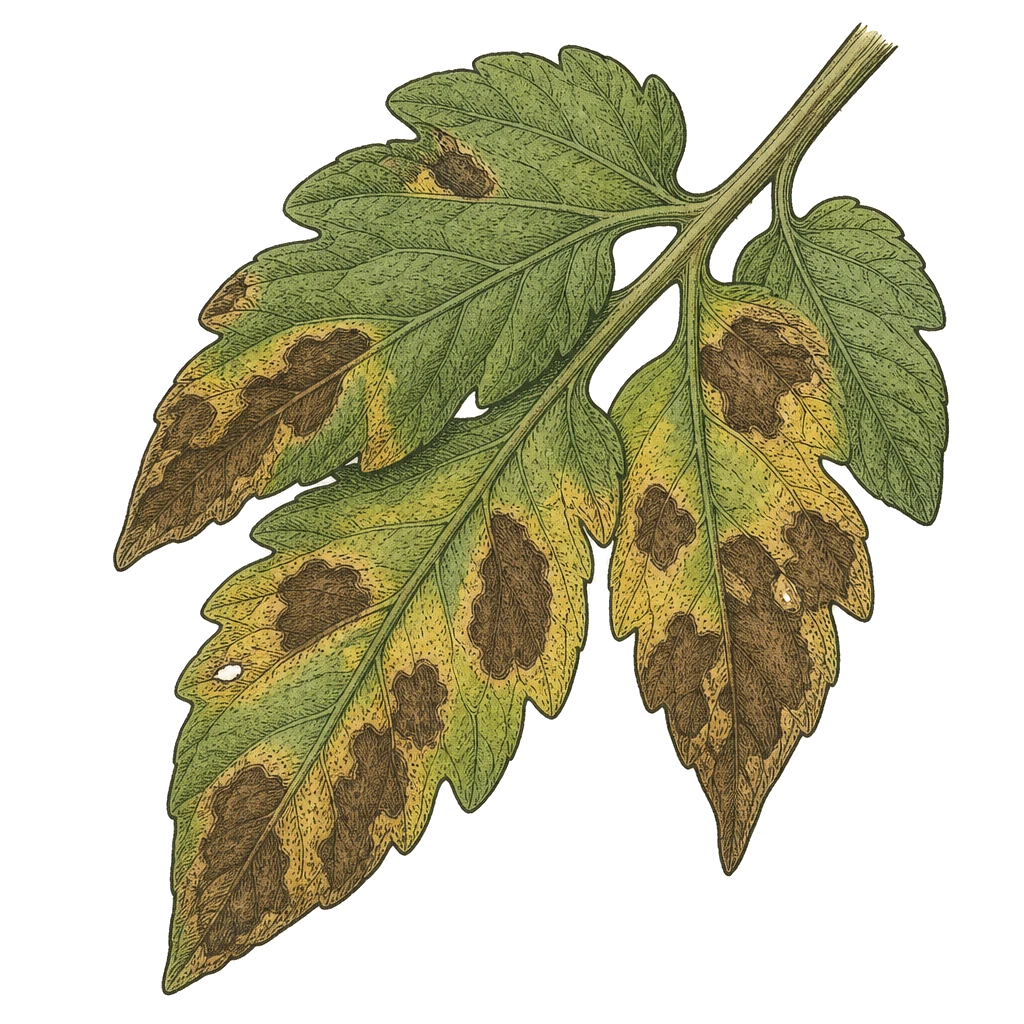
What’s actually happening
Early blight (Alternaria solani) is the most common type in home vegetable gardens. Spores splash up from infected soil and old plant debris when it rains or when overhead irrigation wets the bed. Lesions appear on the oldest, lowest leaves first and spread upward — round dark spots with concentric rings forming a bullseye, sometimes cracking, often ringed with yellow. University of Minnesota Extension reports the pathogen favors temperatures around 82–86°F with relative humidity at 80% or higher; foliage must stay wet for 5–10 hours for germinated spores to infect successfully. The pathogen overwinters in plant debris and soil, not in living tubers.
Late blight (Phytophthora infestans) is not a true fungus but a water mold (oomycete), which matters because standard copper and sulfur fungicides do not work against it. The organism causes water-soaked lesions that can collapse a plant within days under favorable conditions; white sporulation appears on leaf undersides in humid air. Unlike Alternaria, Phytophthora cannot survive in soil or dead plant debris — it must overwinter in living potato tubers (cull piles, volunteer plants) or blow in on windborne spores. Late blight favors cool, wet weather, putting it in a different seasonal niche than early blight’s warm-humid window.
Southern blight (Sclerotium rolfsii) attacks at the soil line. A plant wilts and collapses; the stem base shows a dark brown lesion covered with white, cottony mycelium and small round sclerotia — tan-to-brown, about the size of a mustard seed. Virginia Tech Extension puts the optimal range at 80–95°F with moist soil conditions. The sclerotia persist in soil for years, making this disease a recurring fixture once a bed is infested.
One widespread myth: copper or sulfur spray fixes blight. Both can protect uninfected tissue from new Alternaria infections, but only preventively — they cannot cure existing early blight lesions. Against Phytophthora, they are ineffective without oomycete-specific chemistry. Against Sclerotium, no homeowner-labeled product works at all.
What to do
For early blight, start with cultural controls. University of Minnesota Extension notes that most home gardeners don’t need fungicide at all, because established tomato plants tolerate significant early blight without serious yield loss. Mulch under plants to stop spore splash. Switch to drip or soaker irrigation so leaves stay dry. Stake or trellis for airflow and strip the lowest leaves to break the splash cycle. Rotate out of tomatoes, potatoes, peppers, and any other solanaceous crop for at least 2 years. For variety selection, look for “EB” ratings in catalogs — Mountain Magic, Juliet, Defiant PhR, and Jasper carry documented early blight resistance. See early blight on tomatoes for the full tomato-specific guide.
Late blight offers a home garden no reliable spray program once symptoms appear. Remove and bag the entire infected plant, stems and all; do not compost, and don’t stop at pruning spotted leaves. Pull volunteer tomatoes and potatoes from your property, since these host the pathogen through winter. Avoid wetting leaves in the evening when they stay wet overnight.
For southern blight, remove infected plants and discard the top 2 inches of surrounding soil in the trash. Deep tillage can bury sclerotia below the root zone where they reach stems. Soil solarization — covering moist soil with clear plastic during peak summer heat — can kill sclerotia when soil surface temperatures reach 122°F (50°C). Virginia Tech Extension recommends keeping soil pH above 6.5, since Sclerotium rolfsii is less aggressive in neutral to slightly alkaline conditions.
When you log blight symptoms in Arbor, describe what you’re seeing — bullseye spots on lower leaves, a fast-collapsing plant, or stem rot at the base — and the triage card routes to a treatment task matched to the right disease.
Zone and season notes
Early blight is a risk wherever tomatoes and potatoes are grown. Late blight is most common in cool, maritime climates — the Pacific Northwest and Northeast see it regularly, while hot-summer interior regions rarely do. It also appears as a fall risk in zones 9–11 when gardeners plant tomatoes for a second cool-season crop. Southern blight is primarily a problem in zones 7–11, concentrated in the Southeast, Gulf Coast, and warm California valleys; gardeners in zones 3–6 rarely encounter it.
When to worry / when not to
Early blight on a mature tomato is usually manageable without spraying — strip the lower leaves and the plant will typically carry its fruit load. Late blight is always urgent: a plant can collapse and spread to nearby beds within a week, so act the day you identify it. Southern blight won’t spread rapidly through the air, but the plant is lost once the stem collapses; the priority is containing sclerotia spread to adjacent soil.
If what you’re seeing is a white powdery coating rather than spots or stem rot, see powdery mildew on vegetables. For spots without the bullseye pattern, see leaf spot diseases.
Sources
- University of Minnesota Extension — Early blight in tomato and potato
- University of Minnesota Extension — Late blight of tomato and potato
- University of Maryland Extension — Southern Blight of Vegetables
- Virginia Tech Extension — An Overview of Southern Blight (Sclerotium rolfsii)
- NC State Extension — Tomato Late Blight
- University of Minnesota Extension — Early blight (Alternaria Leaf Blight) on Brassica
- University of Maryland Extension — Checking for Phytophthora blight