
Leaf Spots on Vegetables: Fungal or Bacterial?
Spots on vegetable leaves come in two kinds, fungal and bacterial, and the honest truth is you usually can’t tell which by looking — and it rarely changes what you do. Neither a fungicide nor a bactericide cures a spot that’s already there; both only protect leaves that aren’t infected yet. So the real work is cultural: pull the worst-spotted leaves, stop wetting the foliage, clean up debris, and rotate the crop next year. Most leaf spots are cosmetic to moderate. The exceptions worth real effort are the wet-season tomato blights that strip a plant from the bottom up.
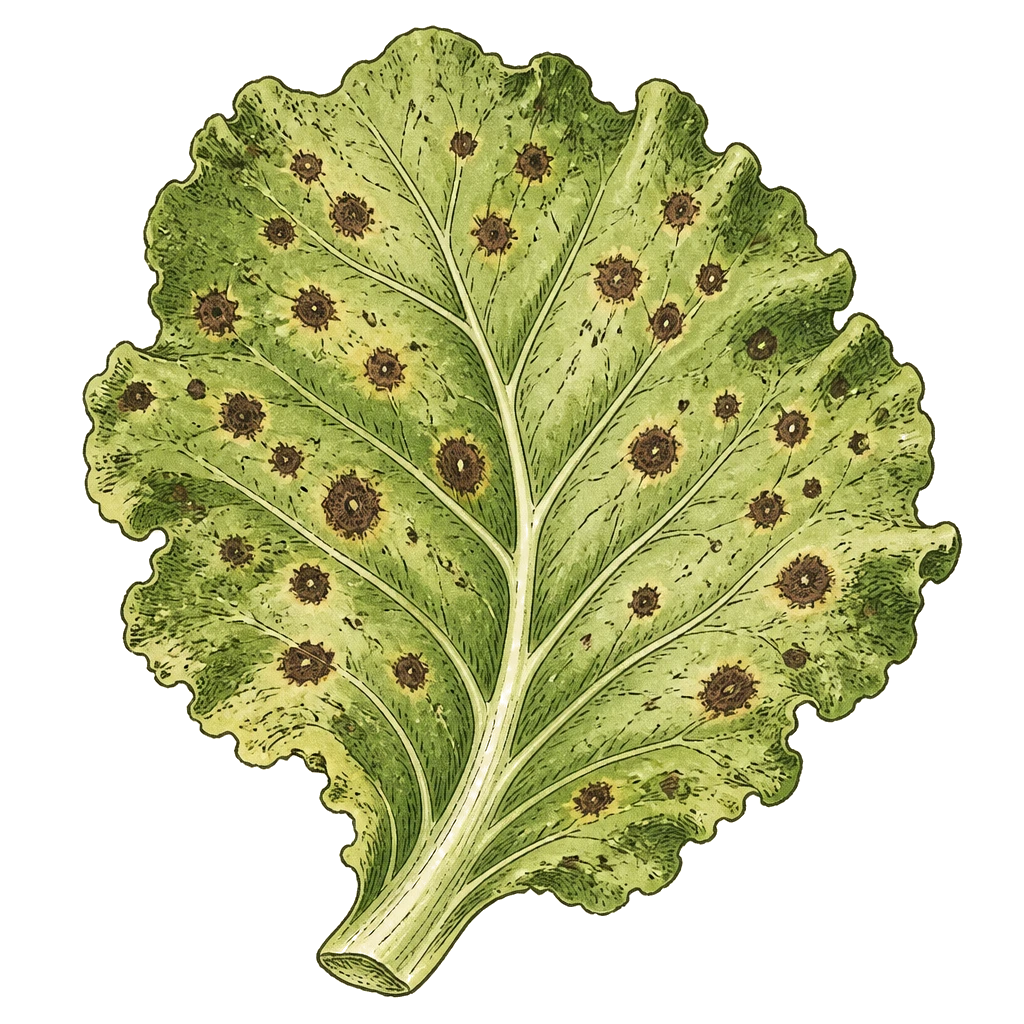
What’s actually happening
A fungal spot tends to be round with a defined edge. Septoria leaf spot, one of the most common on tomatoes, makes spots roughly an eighth to a quarter inch across (extension programs vary on the exact size), with a pale center, a dark rim, and often a yellow halo; look closely and you’ll see tiny black specks in the middle, which are the fungus’s fruiting bodies. By contrast, the early blight covered in its own guide makes bigger brown spots with concentric rings, like a target. A bacterial spot reads differently: it starts water-soaked, turns brown, may or may not carry a yellow halo, and because the bacteria get trapped between leaf veins, the spots often go angular instead of round.
That’s the textbook version. In a real garden, fungal and bacterial spots overlap enough that a confident eyeball ID is hard, and other diseases can make angular spots too. The useful news is that the response is nearly the same either way, so a confident ID isn’t the thing standing between you and a healthy plant.
Here’s the part that saves money: by the time you can see spots, spraying is mostly too late. UMass’s and NC State’s extension programs are blunt about it — copper and the other home-garden products are protectants, not cures. They shield healthy tissue from new infection and do nothing for a leaf that’s already speckled. Both fungi and bacteria travel by splashing water, and bacteria need several hours of leaf wetness to infect at all, which is why the whole game is keeping leaves dry and clean rather than out-spraying the weather.
What to do
Start by removing the worst leaves, and do it when they’re dry. A heavily spotted lower leaf is a spore factory, and clipping it off does more than any spray. Bag those clippings rather than composting them.
The next lever is water. Switch from overhead watering to drip or a wand at the soil line, and water in the morning so anything that does splash dries fast. Space plants for airflow — wider spacing shortens the leaf-wetness window that infection depends on. A one-inch layer of mulch blocks the soil splash that carries spores up onto the lowest leaves, though don’t pile it on so thick that it traps moisture against the bed.
Sanitation closes the loop. Pull badly infected plants, clear all debris at season’s end, and rotate the affected crop family to a different bed for at least two years, since these pathogens overwinter in old plant matter and infected seed. Seed can carry bacteria, so use certified-clean or hot-water-treated seed.
If you spray at all, treat it as protection for the leaves you’re trying to keep, not rescue for the ones already lost. Copper-based products have some effect, but they only protect healthy tissue and can burn foliage, so copper alone is a weak plan. Read the label and test a few leaves first.
This is a problem where the calendar matters more than the cure, and the calendar is the part most gardens drop. Log a leaf-spot note in Arbor and it prompts you to add a follow-up task for the week, and because it remembers which bed it happened in, it can flag that crop family for rotation when you’re planning next spring.
Zone and season notes
Leaf spot is a humidity disease, so where you garden decides how much you’ll see. In the humid East, Southeast, and Midwest, rain, dew, and long muggy nights keep foliage wet, and fungal spots like Septoria plus warm-weather bacterial spots run as a genuine seasonal load — Xanthomonas is most aggressive at 77–86°F, so expect bacterial spots in the heat of summer and Septoria on tomatoes from fruit set onward in a wet year. The cited programs are all humid-region, but the mechanism generalizes: in the arid West and Mountain zones, dry air suppresses most of it, and when leaf spot does show up there it’s usually self-inflicted by overhead sprinklers wetting the foliage — drip plus morning watering removes the problem before it starts. Cool-weather bacterial spots driven by Pseudomonas, most active at 61–75°F, can turn up in mild spring conditions in either climate.
When to worry and when not to
As a matter of triage: a few spots on lower leaves late in the season, on a plant that’s still producing, means leave it and keep harvesting. Spots racing up a young plant during a wet stretch, or a tomato defoliating from the bottom as fruit sets: act now, because bare stems mean sunscald and lost yield. If a plant is collapsing with water-soaked, mushy, foul-smelling areas rather than discrete spots, that’s bacterial disease gone systemic — pull it, because nothing you spray brings it back.