
Cucumber Beetles and Bacterial Wilt: What to Do
With cucumber beetles, the chewing is the lesser problem. The real threat is bacterial wilt, a disease they spread that has no cure once a plant catches it, so the whole job is keeping beetles off while the plants are young and most vulnerable. Lay floating row cover over cucumbers and melons from the day they emerge. Pull it at flowering so bees can reach the blossoms, and handpick or treat any beetles that slip underneath. Cucumbers and muskmelons are the ones at real risk; squash and pumpkins mostly just get chewed, and watermelon is highly resistant to the wilt.
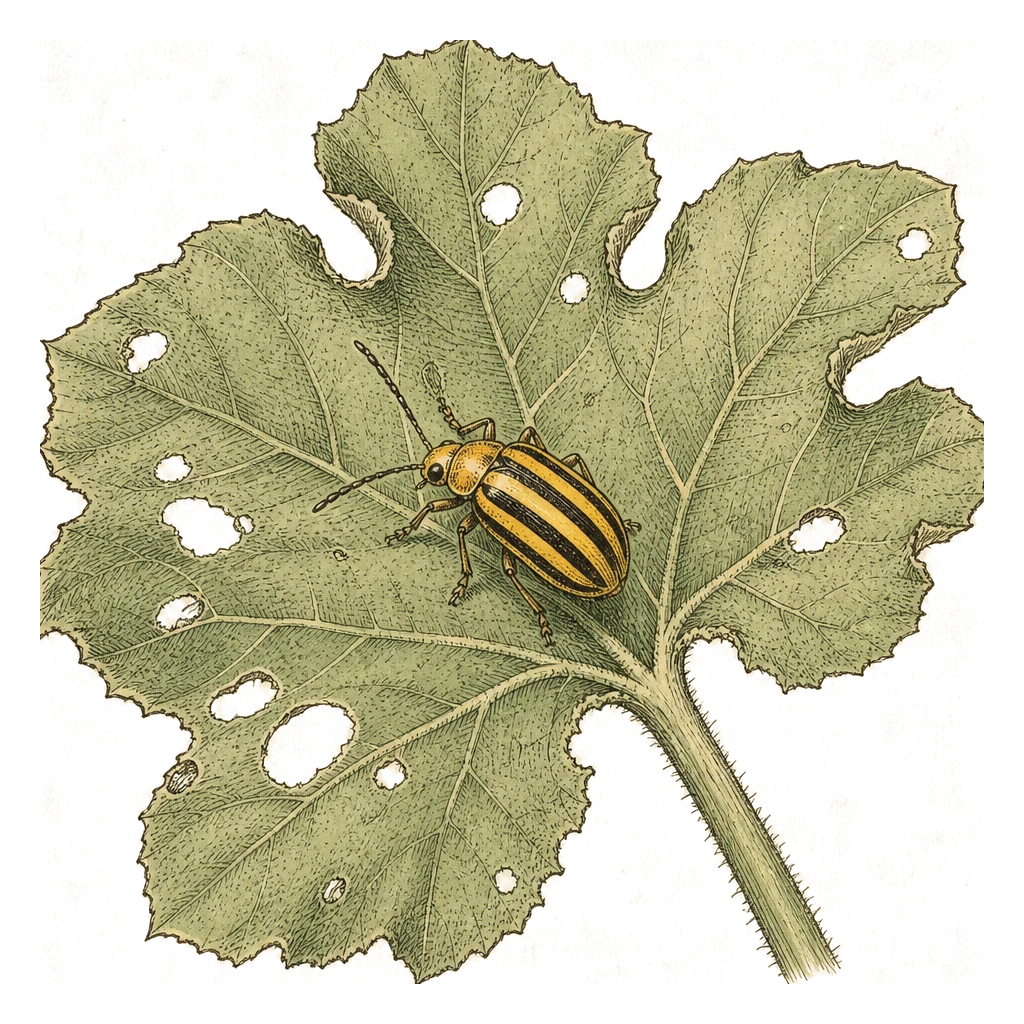
What’s actually happening
Two beetles share the name. The striped cucumber beetle matters most: roughly a fifth to a quarter of an inch long, yellow with three black stripes, and it overwinters locally, so it’s there for the earliest seedlings. The spotted cucumber beetle, yellow with twelve black spots, arrives later in summer and spreads disease less reliably. Both chew foliage and flowers; their larvae feed on roots below.
The chewing isn’t the headline, though. Striped beetles carry the bacterium Erwinia tracheiphila in their gut through winter. A carrier feeds, leaving bacteria in the wounds and its droppings; those multiply and clog the vessels that move water up the vine, and the plant wilts and dies. Once a plant is infected there’s no cure and nothing to spray; you pull it. The bacterium doesn’t survive in the soil, so it arrives each year inside the beetles, not from the bed. Pulling an infected plant keeps it from feeding the next beetle, but won’t protect neighbors from beetles already in the patch.
This is why “wait and see” backfires. Wilt symptoms (leaves flagging by day, reviving a little at night) can take as long as two to six weeks to show, per Maryland Extension, and by then the infection is done. Keep beetles off before symptoms appear. To confirm wilt, cut a drooping stem near the base, press the cut ends together, and pull them slowly apart; fine threads of ooze stringing between them are the signature.
What to do
Protect the seedlings first, because that’s when it counts. Beetles do the most harm from emergence through the third true leaf, and a few become a crowd fast. Floating row cover over young cucumbers and melons, on from the day they sprout, is the most effective single move you have. Pull it the moment they flower, though, or bees can’t reach the blossoms to set fruit.
A trap crop buys the main planting some peace: beetles strongly prefer certain squash (Blue Hubbard is the standard), so a ring of it sown a week or two ahead draws them off your cucumbers, where you can knock them into soapy water or spray the trap crop alone. Straw mulch around the base makes egg-laying harder.
For a few plants, handpicking works: tip beetles into soapy water in the cool of early morning when they’re slow. To cut feeding more broadly, kaolin clay, a fine mineral film, deters beetles if applied before they arrive in numbers. Either way, pull any plant showing wilt right away so it can’t feed the next beetle. How many beetles is too many depends on the crop. On cucumbers and muskmelons, Maryland and Illinois Extension put the action bar at one beetle per plant; Minnesota sets it higher, at two or more on a quarter of the plants. Err toward the lower number on young plants, where wilt risk is highest. On established squash and pumpkins, treat only when beetles strip about a quarter of the leaves.
This is a crop where the calendar does the work, and those dates slip in a busy spring. Log your cucumber or melon planting and Arbor prompts the row-cover task at emergence and the reminder to pull it at flowering, and a note like “striped beetles on the seedlings” gets flagged urgent for the week.
Spraying is a last resort, and a blunt one, since these plants need bees. If you must, spray in early morning or evening, when bees aren’t foraging, and target the first adults before the population builds.
When to worry and when not to
On cucumbers and muskmelons, treat beetles as serious from the moment seedlings break ground: these are the plants that catch incurable wilt. On squash and pumpkins, relax once plants are established; they take heavy feeding in stride and rarely die of wilt. Late-season nibbling on fruit skin is cosmetic, and watermelon is highly resistant to the wilt.
Zone and season notes
The disease threat is the same everywhere; what shifts is the timing and the number of rounds. Striped beetles get going once temperatures reach the mid-50s to low-60s °F, so in warm zones (9–11) they emerge early and run two or more generations, and pressure lasts much of the season. Cover seedlings as soon as they’re up, and keep scouting through summer. Watermelon is the melon to lean on where beetles run heavy, and among cantaloupes the tolerant varieties (Athena, Aphrodite) help.
In cold-winter zones the striped beetle usually runs one generation, but emergence varies. Where it overwinters locally, as in Minnesota, it appears around the first week of June; where it doesn’t, as in Nebraska, extension reports it migrating in on southerly winds in early July. Time row covers by your own first sightings, not a fixed date.
Sources
- University of Minnesota Extension — Cucumber beetles
- University of Minnesota Extension — Bacterial wilt of cucurbits
- University of Maryland Extension — Cucumber Beetles: Spotted or Striped on Vegetables
- University of Maryland Extension — Striped Cucumber Beetles and Bacterial Wilt
- University of Illinois Extension — Cucumber Beetle
- Texas A&M AgriLife Extension (Aggie Horticulture) — Cucumber Beetle
- Nebraska Extension — Bacterial Wilt of Cucurbits (G2023)