
How Often to Fertilize a Vegetable Garden
How often you fertilize depends far more on the kind of fertilizer than on the crop. Granular fertilizers — organic or synthetic — feed slowly and get reapplied about every 4 to 6 weeks. Water-soluble liquids like fish emulsion or Miracle-Gro act fast and wash out fast, so they go on every 1 to 2 weeks at the low end of the label’s rate. Pick one product and follow its cadence; the most common mistake is reading a liquid-fertilizer schedule onto a granular product, or the reverse.
How it works
The number that matters isn’t really on the front of the bag (the N-P-K ratio) — it’s the release rate, which usually isn’t printed at all. It comes down to how the nutrients get out of the product and into the soil.
Granular fertilizers release over weeks. Organic granular blends — feather meal, bone meal, composted poultry manure — have to be broken down by soil microbes before roots can take anything up, so they meter out over several weeks. UF/IFAS notes this is exactly why organic products “may take a long time to release nutrients,” sometimes slower than the plant would like in cool spring soil. Synthetic granular works similarly by dissolving gradually, and coated controlled-release prills (the Osmocote type) are engineered to feed for the multi-month window printed on the label, often three to six months, from a single application. The practical upshot is the same across all of them: reapply roughly monthly, or on the label’s interval. Real-world bags bear this out — a common organic vegetable granular lists 4–6 weeks; a more concentrated formulation of the same brand lists 6–8.
Liquids release immediately and leave nothing behind. NC State Extension puts it plainly: the nutrients in liquid fertilizers are available to plants right away but don’t last long. You get a fast boost for a transplant or a hungry leafy crop, at the cost of needing to reapply every week or two because the next watering carries the rest past the roots.
This is also why a slow-release granular is harder to misuse. Liquid feeding delivers a concentrated pulse, and a heavy hand burns roots or pushes soft, leafy, fruitless growth. Granular drip-feeds, so the margin for error is wider.
One myth to retire: more fertilizer is not more harvest. Oregon State and others are consistent that excess nitrogen drives leggy leaf growth at the expense of flowers and fruit. A tomato swimming in nitrogen grows a gorgeous bush and few tomatoes.
What to do
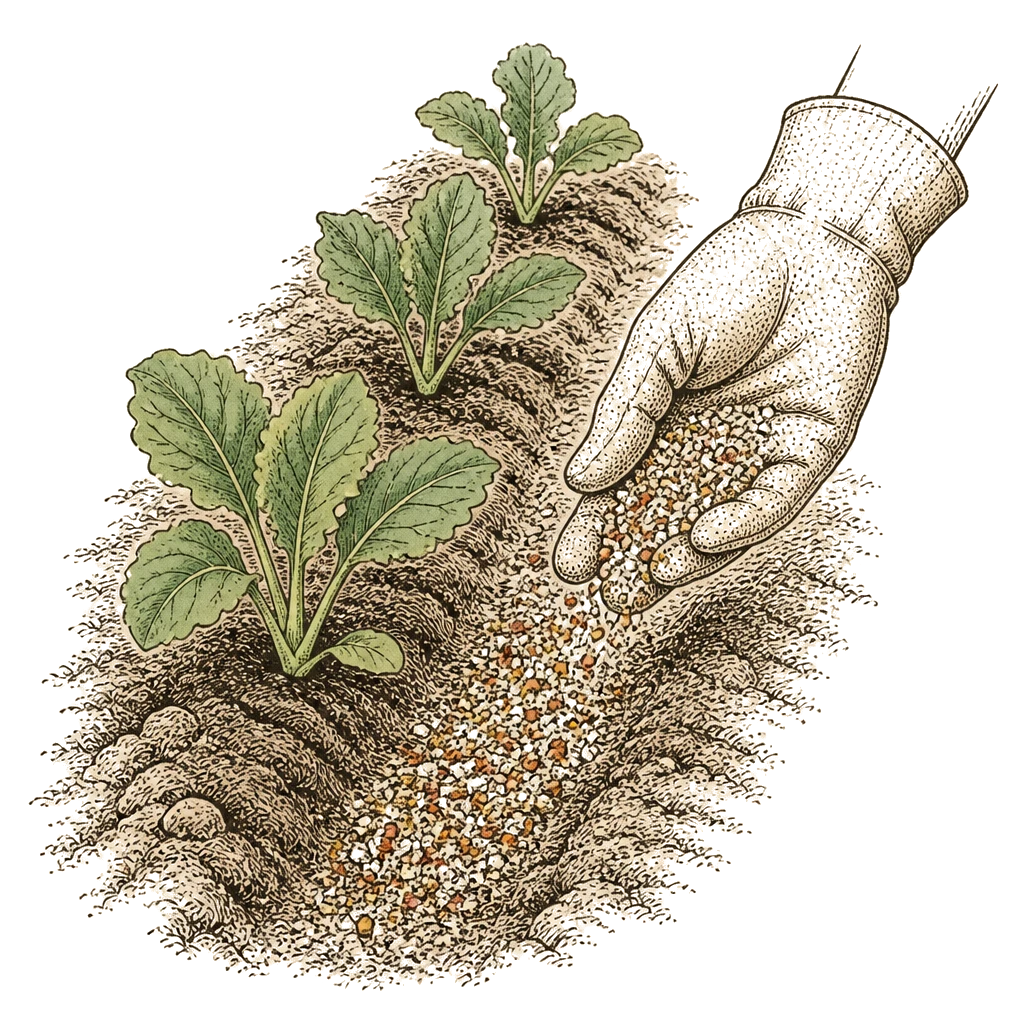
At planting: work a balanced granular fertilizer (a 10-10-10, or an organic all-purpose blend) into the top 2 to 4 inches of soil at the label’s rate for the area you’re planting. Mixing it in matters — granules sitting on the surface get lost to wind and heavy rain before roots ever reach them. Maryland Extension recommends watering it in afterward if no soaking rain is expected.
Through the season, pick a lane:
- Granular (the simplest rhythm): reapply every 4 to 6 weeks during active growth. Side-dress it — a shallow band 4 to 6 inches from the stems, kept off leaves and stems, both of which it can burn — then water it in. This is the schedule Arbor uses by default: a monthly fertilize task per bed, set to the organic-or-conventional preference you chose at setup. The task is sticky, so it rolls forward until you check it off rather than vanishing if you miss the day.
- Liquid (for a faster boost): every 1 to 2 weeks at the low end of the label’s rate, on already-moist soil. Useful for settling in transplants and for leafy greens you harvest repeatedly.
Match the formula to the stage. Maryland and Clemson both note that for most established gardens, nitrogen is the nutrient that actually needs replenishing — it leaches; phosphorus and potassium tend to stick around. But for fruiting crops, ease off nitrogen once flowering starts and lean on a formula with relatively more phosphorus and potassium (a 5-10-10 type), or you’ll get that all-bush-no-fruit problem.
Test your soil once. Maryland Extension puts a basic test at about $11–30 through most state labs, and it tells you whether you even need the P and K you’re buying. Every three years is plenty once you know your baseline. If a test shows P and K are already high, Maryland Extension recommends a nitrogen-only product so you’re not paying for nutrients your soil doesn’t lack.
Zone and season notes
Warm-winter zones (9–11) run close to year-round, so feeding isn’t a spring-only event — each new planting cycle starts the schedule over, and winter rains leach nitrogen even without a freeze. In cool spring soil anywhere, give organic granular a head start by applying a week or two before planting, since cold soil slows the microbes that release it; where the season is short, this also keeps a slow release from peaking after harvest. In cold zones, wind feeding down well before your first frost date rather than feeding late into the fall — late nitrogen pushes tender growth that won’t survive the cold.
Sources
- University of New Hampshire Extension — Slow-Release Fertilizers for Home Gardens and Landscapes
- NC State Extension, Pender County Center — Which Fertilizer Is Best?
- University of Florida IFAS Extension — Controlled-Release and Slow-Release Fertilizers (HS1255)
- University of Maryland Extension — Fertilizing Vegetable Gardens
- University of Maryland Extension — Soil Testing and Soil Testing Labs
- Clemson Cooperative Extension HGIC — Fertilizing Vegetables
- Oregon State University Extension — Feed Your Vegetable Garden Midseason