
How to Thin Seedlings
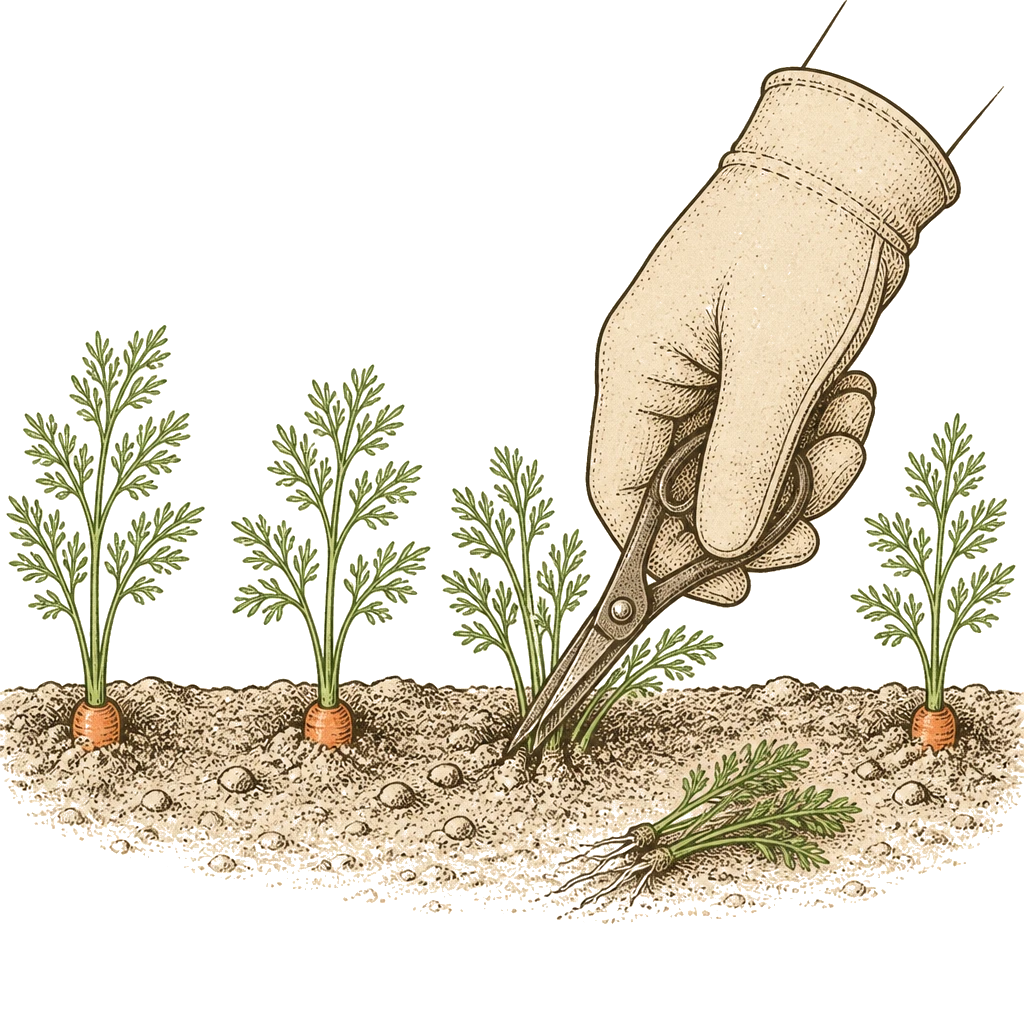
Thin direct-sown seedlings when they reach 1 to 2 inches tall or show 2 sets of true leaves (the leaves shaped like the adult plant’s, which follow the first rounded pair) — whichever comes first. Cut unwanted seedlings at soil level with scissors or snip them off with thumb and forefinger; pulling disturbs the roots of the seedlings you want to keep. The goal is one plant per final spacing, with enough room in the soil for roots to develop without competing.
How it works
The stakes are clearest with root crops. Unthinned carrots, beets, and radishes produce forked, stunted, or non-existent roots — each seedling reaches into the same soil column, and there is no room for a proper taproot when another plant sits an inch away. Above ground the damage is slower to show: crowded plants compete for the same light, moisture, and nutrients, and they trap humid air between leaves in a way that invites fungal disease.
What looks like beet overplanting almost never is. A beet “seed” is actually a corky cluster containing 2 or 3 true seeds, so multiple seedlings per spot are the rule, not an accident. Beets are among the small-seeded crops that most often come up too thick, so plan on thinning them.
Thinnings are not automatically waste, at least not for every crop. Lettuce and spinach thinnings are edible at any size, and undamaged ones can often be lifted and replanted to fill gaps elsewhere in the bed. Bean, squash, cucumber, and melon thinnings should be cut and composted instead — their roots are too fragile to survive the move, and pulling them risks disturbing the roots of the plant you’re keeping.
What to do
Time the work for early evening. The remaining plants have the cool night to recover from any soil disturbance, and seedling clusters are easier to read without midday glare.
Use scissors or snip each unwanted seedling cleanly at the soil line. Cut, don’t pull: a pulled seedling levers against its neighbors, and even a careful extraction can stunt the keepers. The one exception is a lettuce or spinach thinning you intend to replant, which has to come up with its roots — lift that one on its own and cut the rest.
If seedlings are already 4 inches or taller and shading each other, thin anyway — late thinning still improves airflow and root room, though crowded root crops may already show some forking. Cut rather than pull regardless of size.
Spacing by crop
Radishes take 2 inches between plants, beets 3 with all but one seedling per cluster removed, and spinach 2 to 4. Carrots go to 2 to 3 inches apart, thinned once seedlings reach about 2 inches tall. Lettuce ranges from 4 inches for leaf varieties to 8 inches for head types. Beans need 4 inches once their first true leaves appear, and corn needs 8 to 12 inches between plants in a block planting — several short rows side by side rather than one long row.
Squash, cucumbers, and melons need the earliest attention of any crop: thin to one plant per hill (the low mound where several seeds went in together) as soon as the seedlings are up and you can tell them apart. Those plants claim more ground than anything else in the bed — about a foot for cucumbers, two to three feet for squash and melons — which is why a second seedling in the hill costs so much. If the roots have already knitted together, cut at the soil line anyway: one plant set back still beats two sharing the hill all season.
For very crowded sowings, two passes work better than a single aggressive thin. Take out the obvious weaklings first, then come back a week later and go to final spacing. The interval lets you identify the strongest seedlings before committing: keep the one with the thickest stem and most upright posture, and when two look equal, favor the seedling nearer the center of the intended spacing.
The spacing numbers above apply in every direction in a raised-bed block planting, not just along the row: carrots at roughly 3 inches each way.
When Arbor adds a thinning task to your week’s list for a direct-sown bed, it includes the target spacing for that specific crop, so the number is in front of you when you’re at the bed with scissors in hand.
Zone and season notes
In hot-summer zones (8 through 11), thin cool-season crops — lettuce, spinach, and radishes — as soon as seedlings hit the right size. Crowded plants trap heat and exhaust soil moisture faster than spaced ones, which accelerates bolting. A week’s delay in thinning a spring lettuce bed under heat stress can turn a crop into flower stalks before it heads up.
Short-season zones (4 through 6) can thin fall carrots and beets toward the closer end of their spacing, carrots at 2 inches rather than 3, to fit more plants into the bed before frost ends the season.
Sources
- UF/IFAS Extension Escambia County — Thinning Vegetable Seedlings
- NC State Extension — Extension Gardener Handbook, Chapter 16: Vegetable Gardening
- University of Maryland Extension — Growing Lettuce in a Home Garden
- Ask Extension (Cooperative Extension) — To thin seedlings or not
- Colorado State University Extension — Block Style Layout in Raised Bed Vegetable Gardens
- UC Master Gardener Program — Efficient Use of Space
- Oregon State University Extension — Tips for Planting Corn, Beans and Squash
- Cornell Cooperative Extension — Creating a Three Sisters Garden