
Why Are My Vegetable Leaves Turning Yellow?
Yellow leaves are easiest to read with two questions: which leaves are yellowing, old and low or new and high, and what the pattern looks like, the whole leaf or just the tissue between green veins. Old and uniform usually points to nitrogen, or simply to cold, wet soil; new growth going pale between the veins usually means iron locked up by high pH; sudden yellowing with wilting is almost always water, and usually too much of it. The one move to resist is the reflex to fertilize: yellow means the leaf’s supply line is broken somewhere, and fertilizer is the right fix only some of the time.
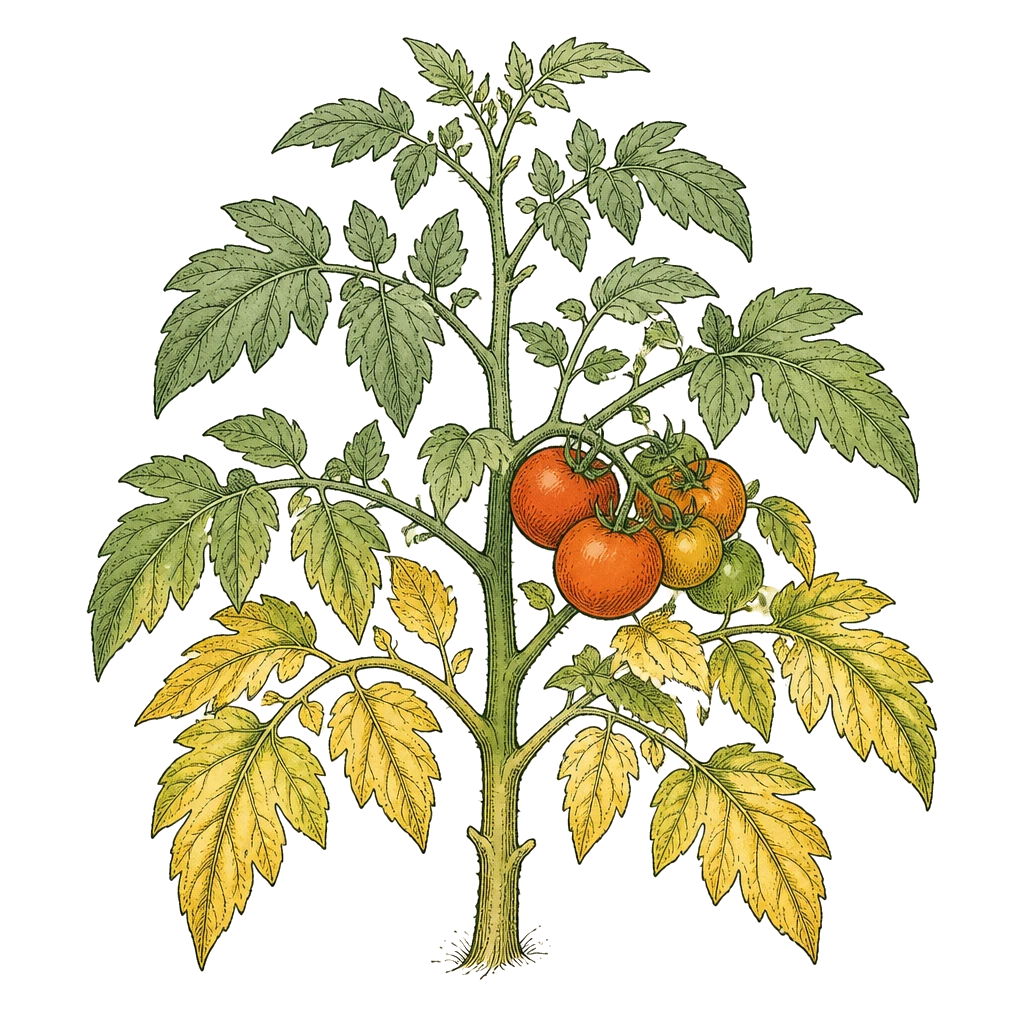
What’s actually happening
Leaves yellow based on whether the missing resource can move inside the plant. Mobile nutrients — nitrogen, phosphorus, potassium, magnesium — get pulled from old leaves to new growth when they run short, so a deficiency shows on the oldest leaves first. Immobile ones — iron, manganese, calcium — can’t be relocated, so a shortage shows on the newest top growth while old leaves stay green.
The shape narrows it further. Nitrogen turns whole older leaves uniformly pale to yellow, starting at the tip. Iron does something distinct: the youngest leaves go yellow between the veins while veins stay green. Magnesium makes that same interveinal pattern but on older leaves, since it’s mobile. Potassium yellows then scorches the margins while the center stays green.
Overwatering, cold soil, high pH, and disease all produce yellowing that mimics a nutrient shortage almost exactly — which is what makes this a decision tree, not a lookup table. Reaching for fertilizer is the single most common wrong move: it does nothing for roots that are drowning or locked out, and the salt can cause its own yellowing when overdone.
What to do
Check the soil before anything else. Push a finger about 2 inches in, to the second knuckle. If it’s soggy, overwatering is your answer: saturated soil drives the air out and the roots suffocate, so the plant yellows and wilts at once even though a wilting plant looks thirsty. Stop watering, pull back any mulch holding moisture against the stem, and let the top 2 inches dry before you water again. If the soil is bone dry instead, underwatering is doing it — water deeply now, then let the top inch dry before the next round. (See the overwatering vs. underwatering guide.)
If moisture checks out, read the pattern. Uniform yellowing of the lower leaves points to nitrogen, though cold or waterlogged spring soil produces the identical symptom without any real shortage. Interveinal yellowing on new growth points to iron, which in most gardens is a pH problem rather than a missing-iron problem. Scorched yellow margins on older leaves suggest potassium. None of these is a call you bet the season on without a soil test, which your county extension office runs by mail for a small fee.
Yellowing that arrives with company — mottling, a mosaic of light and dark, spots, or twisted new growth — is disease, not diet. A mosaic pattern with distorted leaves usually means an incurable virus; since it can’t be cured, pull and bag the plant rather than composting it, so it doesn’t pass to healthy neighbors. Dark, water-soaked, angular patches are bacterial. Discrete spots, sometimes with target-like rings, are fungal leaf spot: strip the affected leaves, improve air circulation, and avoid wetting foliage when you water (see the leaf-spot guide). These are visual reads, so when nothing quite fits, an extension plant-diagnostic lab settles which pathogen you have.
Zone and season notes
In the warm, alkaline-soil West and Mountain zones, interveinal yellowing on new leaves is usually iron chlorosis driven by high pH: the iron is in the soil, but above about pH 6.5 the plant can’t take it up, and it’s most available in the 4.5 to 6.0 range, so the fix is correcting pH, not adding iron. In cold-winter zones early in spring, uniform yellowing of the lower leaves often just means the soil is still too cold for roots to take up nitrogen; the plant greens up on its own once the soil warms, and adding nitrogen won’t fix what cold roots caused.
Log the yellowing in Arbor and it prompts a task, linking back to this guide for the moisture check or soil test that actually fits rather than a bag of fertilizer. It holds the note for next year, so a pattern that recurs every cold spring and clears by June reads as a timing issue, not a fresh deficiency.
When to worry and when not to
Not every yellow leaf is a problem. The oldest, lowest leaves slowly yellowing and dropping as a plant matures, or right after a heavy fruit set, is normal aging — the plant is pulling nitrogen from spent leaves to build new growth and fruit. Worry when yellowing climbs quickly into new growth, spreads alongside spots, mosaic, or distortion, or comes with a wilt that watering doesn’t cure, which points at the roots. A leaf that has already lost its green won’t turn back, so watch the new growth up top to judge whether a fix is working, not the leaves that already yellowed. Resist two reflexes: don’t fertilize first, and with blossom-end rot specifically, check your watering before you reach for calcium (the blossom-end-rot guide covers why).
Sources
- UConn Home & Garden Education Center — Watch Out for These Nutrient Deficiency Symptoms
- UGA Extension — Nutritional Deficiencies in Vegetables (B 1569)
- University of Maryland Extension — Nutrient Deficiency (iron chlorosis and pH)
- UC Statewide IPM Program — Nitrogen Deficiency (Home and Landscape)
- University of Florida Emerging Pathogens Institute — Is your plant diseased or just overwatered?