
Colorado Potato Beetles: ID, Damage, and Control
Colorado potato beetle is a serious defoliator of the entire nightshade family — eggplant, tomato, tomatillo, and pepper, not just potatoes. If you grow any of these crops and see chewed leaves paired with brick-red larvae or yellow-striped adults, act when larvae are young: the 4th larval stage alone causes as much as 75% of the feeding damage on a plant.
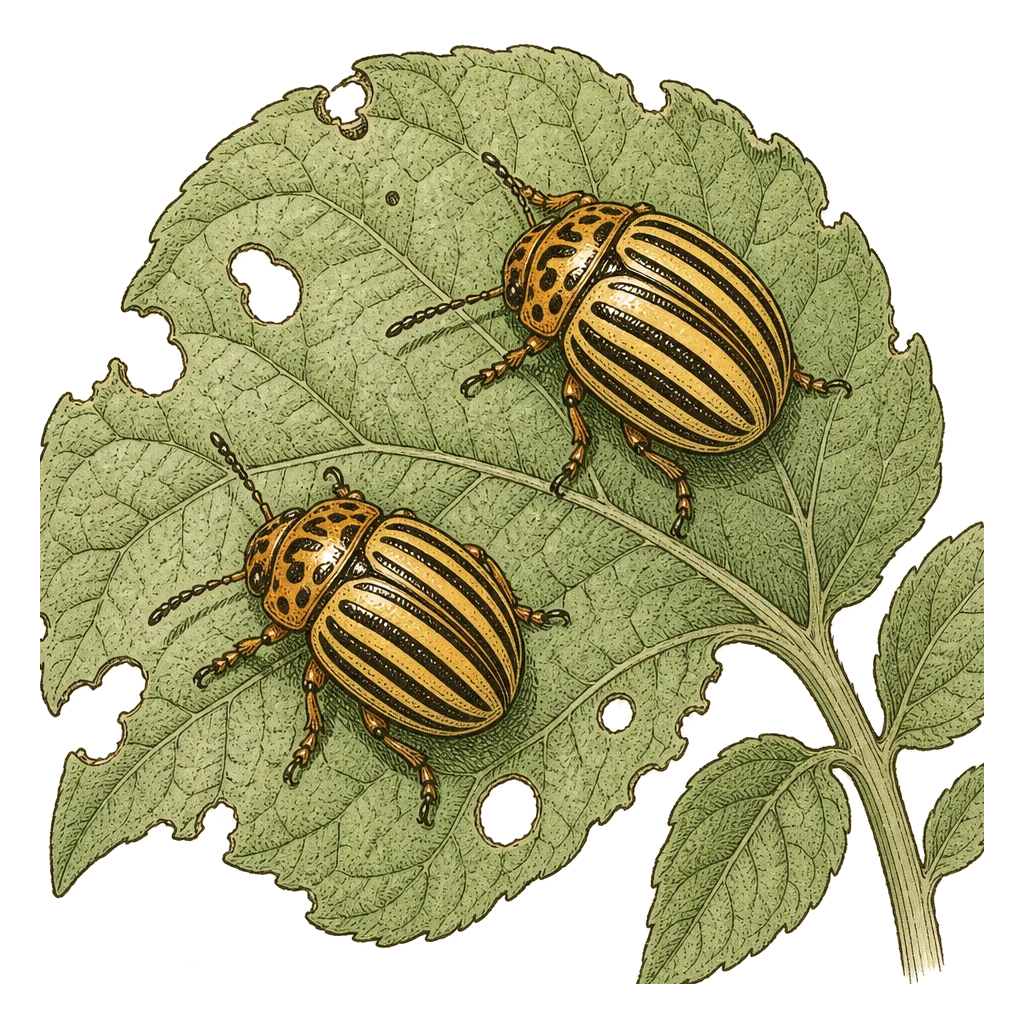
What’s actually happening
Adults are oval, about 3/8 inch long, yellowish with 10 black stripes across their wing covers. They overwinter 5–10 inches underground and emerge in late April through early May in the Midwest and mid-Atlantic. Females lay bright yellowish-orange eggs in clusters of 10–30 on leaf undersides; a single female can produce up to 350 eggs across her adult life.
Eggs hatch in roughly 2 weeks. At that point, four larval stages follow. Young larvae are brick red with black heads; older instars lighten to pink or salmon with two rows of dark spots on each side. Instar 1 is pinhead-sized (under 1/8 inch); instar 2 reaches about 1/4 inch. Past 1/4 inch and lightening toward pink, larvae are beyond the stage where Bt works well. Development speed depends heavily on temperature — larvae mature in about 10 days when daytime averages are in the mid-80s °F, but take more than a month when temperatures hover near 60°F. Central and southern areas typically see 2 generations per year; cooler northern gardens usually see 1.
University of Maryland Extension notes that eggplant is actually a favorite host — often preferred over potato. Garden weeds including nightshade and ground cherry also harbor the pest, giving beetles places to build up before moving to crops.
What to do
Start with physical barriers and rotation. Row cover applied before adults emerge from the soil in spring is highly effective — coverage applied after you first spot beetles buys little. Time the cover to local soil emergence (late April through May in most regions; see Zone and season notes for your window). Crop rotation of at least 1/4 mile from a previously infested bed meaningfully reduces early-season colonization. Most home gardens cannot achieve that distance; there, lean on row cover as the primary barrier and a trap-crop row of eggplant to concentrate beetles for removal. Choosing varieties that mature in fewer than 80 days can help escape heavy late-season pressure.
Monitor before you spray. Check 50 plants every 3–4 days; with fewer than 50 plants, scout all of them and apply the same percentage thresholds, since the math scales to any plot size. Potatoes tolerate up to 30% defoliation before flowering; that threshold tightens to about 10% during tuber sizing, when the crop is most vulnerable. University of Maryland Extension found that 20% defoliation noticeably reduces yield. For eggplant, peppers, and tomatoes, treat when larvae are still in early instars — before the most damaging 4th stage.
Thick straw mulch is worth the trouble. A deep layer makes it harder for newly emerged adults to reach plants from the soil below, and harder for mature larvae to burrow down and pupate.
Handpicking works for small plots. A few minutes of scouting in the morning, when beetles are sluggish, can remove egg masses and small larvae before populations build. Eggplant and potato are otherwise poor bed-mates, but a sacrificial eggplant planted nearby functions as a trap crop: beetles preferentially colonize it, concentrating populations where you can remove them.
Biological and low-residue options come next. Bacillus thuringiensis (Bt) targets young larvae most effectively — timing matters, apply when most larvae are still in instars 1 or 2. Spinosad (sold as Entrust for organic use) and neem oil are additional options. The fungus Beauveria bassiana is labeled against both larvae and adults.
Reserve synthetic insecticides for genuine pressure — and rotate modes of action. Colorado potato beetle has documented resistance to more than 50 active ingredients spanning every major insecticide class. Switching “products” often means choosing a different trade name in the same mode-of-action group, which does nothing to reset resistance. If you log a scouting note in Arbor when you first find egg masses, it flags the pest as urgent and prompts a treatment task timed to when larvae are still young enough for Bt to work.
Zone and season notes
The spring emergence window is the critical intervention point. In the Midwest and mid-Atlantic, that window runs late April through early May; gardeners in cooler northern zones should watch for emergence a few weeks later as soil temperatures rise. In warm-winter zones (9–11), a second or third generation is biologically plausible, though extension sources specific to those zones are thin — scout aggressively after the first generation pupates.
Thresholds: when to act
A handful of adults on a mature tomato plant is not an emergency — adults alone rarely trigger the threshold. Worry when you find egg masses and small larvae together: that combination signals a generation is building, and the heaviest feeding is still ahead. A potato planting that reaches 30% defoliation before flowering will lose yield even if you intervene afterward.
If you grow eggplant, treat it as the canary: beetle pressure shows up there early and hard. Heavy feeding before first fruit set noticeably reduces yield.
Defoliation itself does not affect the safety of tubers or fruit. If you applied a synthetic insecticide, observe the pre-harvest interval printed on the label before you harvest.