
Flea Beetles on Vegetables: When to Act and When to Wait
If your leaves look peppered with tiny round holes and small dark beetles spring away when you brush the plant, that’s flea beetles. On seedlings and young transplants, act: cover them with floating row cover while they’re small and vulnerable. On established plants the damage looks alarming but rarely matters — they outgrow it as the season warms and the beetles thin out, so you can usually leave them alone. Save the spray for seedlings under real pressure, not cosmetic holes on a four-foot tomato.
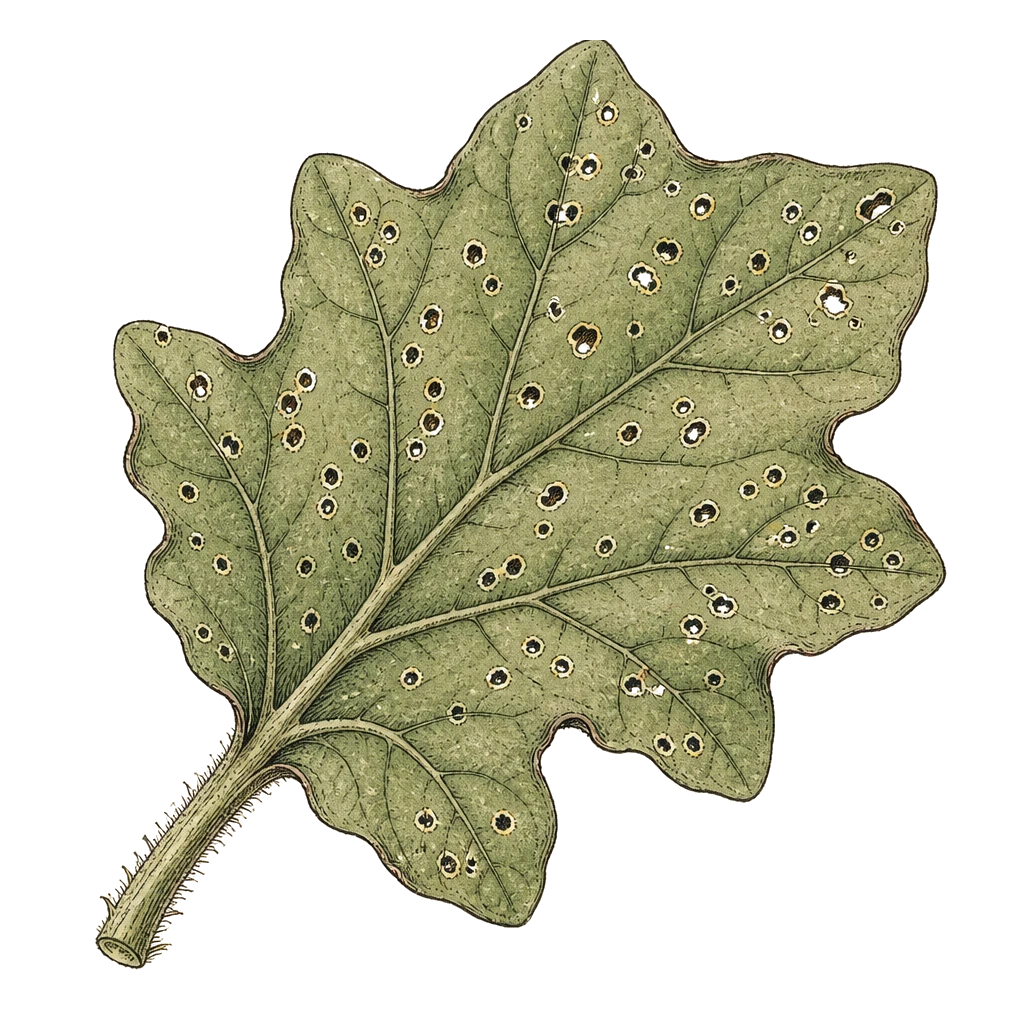
What’s actually happening
Flea beetles are a large group of small leaf beetles, roughly 1/16 to 1/8 inch long and shiny black, bronze, blue, or brown. Their enlarged hind legs let them jump like fleas when disturbed. They chew shallow pits and small rounded holes, usually under 1/8 inch across, scattered over the leaf — the “shothole” pattern that’s distinctive enough to ID them on its own. Adults do the visible feeding; the larvae live in the soil chewing roots and, for most species, cause little real harm (the potato flea beetle is the exception).
Most flea beetles are picky eaters. One group works the brassicas (broccoli, cabbage, kale, radishes, turnips) and another works solanaceous crops like eggplant, potato, tomato, and pepper, with eggplant a particular favorite. A wave of holes on your kale doesn’t mean your tomatoes are next.
The part most garden sites skip: the damage usually looks worse than it is. Extension guidance is consistent that established plants tolerate heavy flea beetle feeding. The real risk falls on seedlings and direct-sown crops, which have little leaf area to spare — a beetle load that’s cosmetic on a mature plant can stunt or kill a two-inch seedling. Once a plant is established with leaf area to spare it can usually ride out the feeding, and adult numbers fall as spring turns to summer anyway.
What to do
Start with exclusion; it’s the highest-value move on the plants that need protecting. Cover seedlings and new transplants with floating row cover as soon as they’re in the ground, sealing the edges to the soil so beetles can’t slip under. For eggplant, set the cover on hoops instead of letting it rest on the leaves. Pull it off once plants flower so pollinators can reach them; by then the plants are large enough to take the feeding.
Clean up around the beds. Flea beetles overwinter as adults in leaf litter and crop debris, so clearing spent plants in fall cuts next spring’s population, and keeping weeds down removes the alternate hosts they feed on early.
A trap crop can pull pressure off the main planting: a highly attractive crop like radish or mustard, sown one to four weeks ahead and kept to about 10% of the area, draws beetles to itself so you treat the trap, not the bed. Kaolin clay (sold as Surround) coats leaves in a gritty feeding barrier; extension results range from a marked reduction in feeding to mixed outcomes, and you reapply at the label rate after rain.
If seedlings stay under heavy pressure despite cover, treat with an insecticide. Spinosad is the usual organic choice; pyrethrins, carbaryl, and permethrin are also labeled. Reapply every one to two weeks, since the beetles re-invade. Pull the cover to spray, then replace it. On most seedlings, more than five beetles per plant is the threshold to treat rather than spraying on sight. For eggplant, the University of Minnesota sets it by plant size: two beetles per plant under three inches, about four at three to six inches, eight past six inches.
Knowing whether a planting is past the danger window is the hard part, and it shifts week to week. Log “flea beetles on the eggplant starts” in Arbor and it flags the seedlings as urgent, drops a row-cover task on this week’s list, and notes the date so next spring it reminds you to cover before the beetles arrive rather than after.
Zone and season notes
This isn’t a pest that splits into a warm-zone and a cold-zone version — it’s a spring problem nearly everywhere, driven by overwintered adults emerging as the soil warms and heading straight for the earliest tender growth. What shifts by climate is timing and the length of the pressure window. Populations run high after mild winters, so gardeners in warm-winter regions see earlier emergence and a longer feeding stretch, sometimes overlapping two generations.
In cold zones the same biology compresses into a sharp spring spike: beetles appear over a few weeks just as seedlings go in, hammer them, then taper as summer heat builds and crops size up. Hot, dry springs intensify pressure either way. The playbook doesn’t change with the zone: protect seedlings, let established plants ride it out. Warm-zone gardeners just need row cover ready earlier and on longer than a cold-zone garden’s spring-spike calendar.
When to worry and when not to
Shotholes on a mature, vigorous plant are cosmetic — leave them and skip the spray. The cases that earn a response: seedlings and direct-sown crops chewed faster than they can grow, eggplant under steady pressure (the crop flea beetles punish hardest), and any planting where 10 to 30% of the seedling leaves are dropping. Once seedlings establish, with beetle numbers falling into summer, most plantings clear the danger on their own.
Sources
- University of Minnesota Extension — Flea beetles
- University of Maryland Extension — Flea Beetles on Vegetables
- Utah State University Extension — Flea Beetles on Vegetables
- South Dakota State University Extension — Dealing With Flea Beetles
- University of New Hampshire Extension — How do I get rid of flea beetles in my vegetable garden?
- Washington State University Extension — Organic Management of Flea Beetles