
How to Grow Broccoli: Spacing, Feeding, Harvest
Set broccoli transplants 16 to 24 inches apart, with 24 to 36 inches between rows, in soil with a pH of 6.0 to 6.5 — anything from 5.5 to 6.8 still grows a crop. Expect a cuttable central head 55 to 65 days after transplanting, give or take what your seed packet says for the variety. Keep the soil evenly moist, feed it as a nitrogen-hungry crop, and time the crop so heads finish before sustained heat arrives. Get those right and the rest of the guide is detail.
How it works
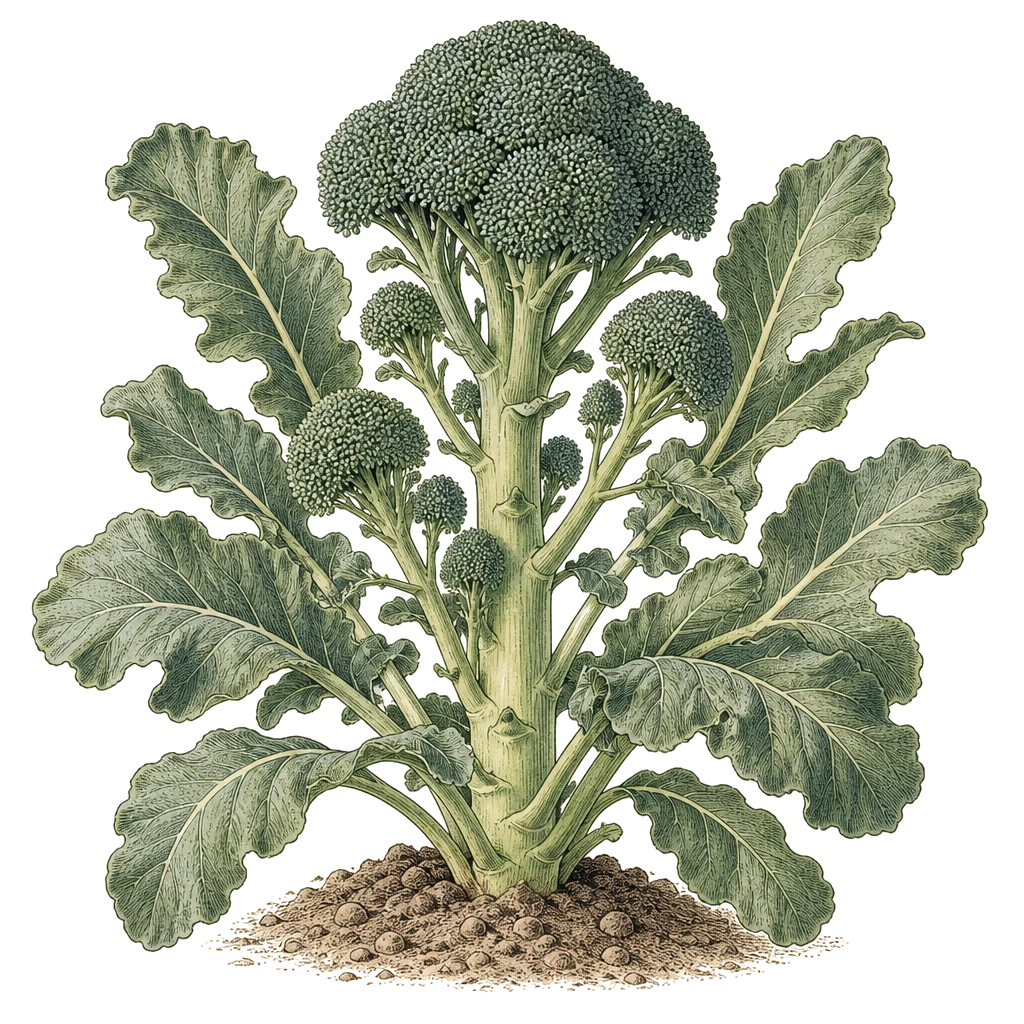
Broccoli forms its head fastest in a fairly narrow temperature band. Head development is best between 54°F and 68°F, and growth slows once temperatures drop below 41°F, so both a hard cold snap and a hot stretch push the crop off its ideal pace. Among the brassicas — the cabbage family, which also takes in cauliflower and kale — broccoli is a comparatively heavy nitrogen feeder, so it wants a richer fertility schedule than most of its relatives grown in the same bed.
The most common broccoli disappointment, a small head that forms too early, isn’t a disease. It’s called buttoning, and it happens whenever something checks the plant’s vegetative growth before it’s built enough leaf mass to support a full-size head. Transplant stress, drought, weed competition, insect damage, low soil fertility, or several days of cold weather below 50°F can all trigger it, and older, root-bound transplants button more readily than young, fast-growing ones.
The fix isn’t a spray. It’s keeping growth uninterrupted, especially in the first few weeks after transplanting.
What to do
Planting and spacing
Start seed indoors and set out stocky transplants, 5 to 6 weeks old and carrying 4 to 6 true leaves (the broccoli-shaped ones that follow the first pair of rounded seed leaves), about 4 weeks before your last spring frost. The bed wants full sun. For a fall crop, start seed 4 to 6 weeks before you plan to transplant. Harden them off first, since transplant stress is one of the things that sets off buttoning — the hardening-off guide has the schedule. Avoid transplants that are already leggy or root-bound, since those tend to button.
Space plants 16 to 24 inches apart in-row, with 24 to 36 inches between rows. Where you land in that range is a real choice: 16 to 18 inches gives you more heads of moderate size, while stretching toward 24 inches grows the largest single heads and raises the odds of hollow stem — a pithy, hollow core running up the middle of the stalk. If you found that last season, tighten the in-row spacing before you change anything else.
Hollow stem tracks with wide spacing and heavy nitrogen, not a boron shortage. Boron deficiency can produce a hollow stem in a controlled experiment, but field cases don’t consistently line up with low boron, and boron sprays aren’t a recommended fix. If you slice a stem and find it pithy, don’t reach for a supplement.
Feeding and watering
At transplanting, apply a starter fertilizer at the rate on its label. Side-dress about 4 weeks later — scatter the fertilizer alongside the row, a few inches out from the stems, and water it in — using 1/2 cup of 21-0-0 per 10 feet of row, which covers roughly five to seven plants at this spacing. Give another 1/4 cup per 10 feet of row once the forming head is about the size of a quarter, roughly an inch across.
Treat that as the whole nitrogen program for the head: hollow-stem risk climbs with higher nitrogen rates, so more is not better here. Right after you cut the central head, side-dress once more with the same nitrogen fertilizer, since that push of nitrogen is what drives strong side-shoot production.
Broccoli’s roots are shallow, so water deeply and evenly, aiming for 1 to 2 inches a week and working toward the top of that range once heads begin to size up; uneven moisture during head formation is one of the more reliable ways to end up with small or loose heads. If you log “broccoli heading up” as a note in Arbor, it flags the crop’s higher water need for that stage and adjusts the coming week’s watering task.
Harvesting the head and side shoots
Harvest the central head while the florets are still tight and dark, before any yellow petals show, once the head is roughly 4 to 8 inches across, depending on variety. Cut with about 5 to 6 inches of stem attached. After that cut, side shoots develop where the lower leaves meet the stem, producing smaller heads around 1 to 3 inches across that extend the harvest for several more weeks. Broccoli is also one of the vegetables aphids commonly colonize, often clustering in the developing head where they’re easy to miss; see aphids on vegetables if you spot them.
Zone and season notes
Broccoli is a cool-season crop everywhere it’s grown, but the risk it runs varies by zone. Established plants shrug off short cold spells down to about 28°F, so spring crops can take a late-season frost in stride. The bigger threat to spring plantings is the other direction. Heads need to size up before sustained heat arrives, since days above 86°F with nights above 77°F can keep plants vegetative instead of heading, and high heat leaves the heads that do form loose and bitter.
That’s why fall crops often outperform spring ones in mild-winter zones (9–11) — they mature into cooling weather, and in those zones side-shoot production can continue well into fall. In colder zones, that same side-shoot window gets cut short once hard freezes set in, so the harvest stretch after the central head is shorter than it would be in a milder climate, even though the plants themselves tolerate the early frosts that end the season. For broccoli’s closest relatives in the cabbage family, see growing cabbage and growing cauliflower; cauliflower runs less tolerant of that same heat-and-cold squeeze than either broccoli or cabbage.
Sources
- University of Maryland Extension — Growing Broccoli in a Home Garden
- Illinois Extension — Broccoli (Home Vegetable Gardening)
- Ohioline (Ohio State University Extension) — Growing Broccoli in the Home Garden (HYG-1605)
- NC State Extension Publications — Basics of Broccoli Production
- University of California IPM (UC ANR) — Buttoning in Broccoli and Cauliflower
- NC Cooperative Extension, Pender County Center — Tips for Harvesting Broccoli
- UMass Amherst Center for Agriculture, Food & the Environment — Brassicas, Hollow Stem
- University of Delaware Cooperative Extension — Weekly Crop Update: Physiological Disorders of Cole Crops
- Washington State University, Mount Vernon (Pacific Northwest Vegetable Extension Group) — Broccoli Boron Deficiency
- Utah State University Extension — Broccoli in the Garden
- University of Minnesota Extension — Growing Broccoli in Home Gardens