
How to Stake and Support Vegetables
Install your stakes and cages the day you transplant, not two weeks later when the plants look like they need them. Roots spread wide and fast; driving a stake into an established root ball tears the fine feeder roots the plant depends on. What you install depends on the plant: a vining tomato takes a 6- to 7-foot stake or a home-built cage, a compact bush tomato is fine on a 4-foot stake, and climbers like cucumbers, peas and pole beans want a trellis or a tepee. And if the plants are already leaning, still stake them — drive the stake outside the root ball rather than through it, tie loosely, and don’t rock it back and forth once it’s set; some fine-root disturbance beats leaving the plant to sprawl.
How it works
Keeping foliage and fruit off the ground does several things at once. It reduces contact with soil pathogens that cause fruit rots, cuts the risk of sunscald by letting air move around the fruit, and makes picking faster. Trellising also improves air circulation around plants, slowing the spread of leaf diseases.
The myth that trips up most first-year gardeners: standard retail tomato cages are sufficient. They aren’t, not for indeterminate (vining) types. Most store-bought wire cages stand only 2 to 4 feet tall. An indeterminate tomato can reach 6 to 8 feet, and a cage that ends at waist height does nothing for the top two-thirds of the plant. Build your own instead, from concrete reinforcing wire (remesh) or welded wire fencing. Pick a 5-foot-wide roll with 6-inch mesh, wide enough to reach through at harvest without tools. Cut a 56- to 60-inch length, bend it into a cylinder about 18 inches across, and hook it shut by folding the cut wire ends back over each other. The width of the roll becomes the cage’s height, so 5-foot fencing stands 5 feet tall. Cages built this way run 5 to 7 feet tall depending on the fencing you start with.
What to do
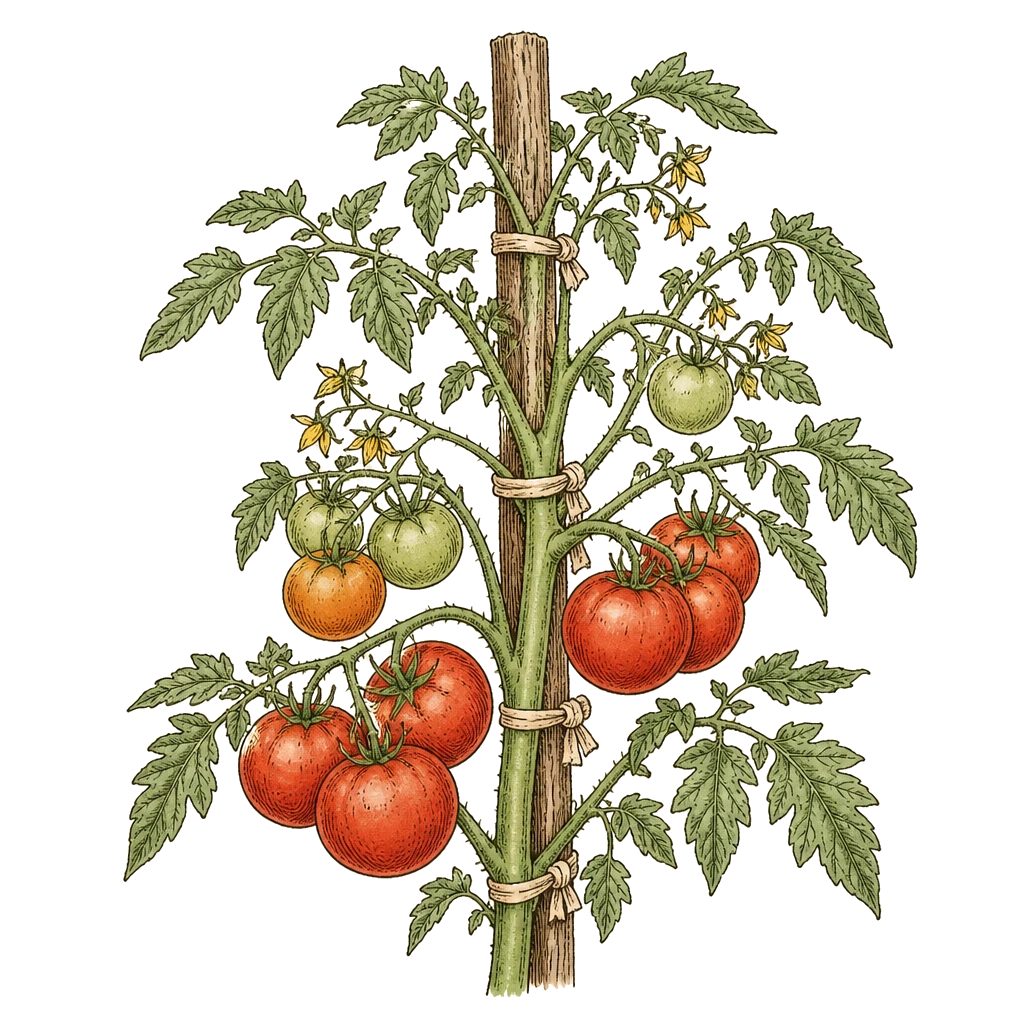
Stakes for tomatoes. For indeterminate varieties, use wooden or metal stakes 6 to 7 feet long and 1½ to 2 inches wide; a thinner cane can bend under a loaded plant no matter how tall it is. Determinate (bush) varieties are more compact and a stake 4 feet tall is usually enough. Check the plant tag or seed packet to tell them apart: a label marked “indeterminate,” or one that gives no mature height, calls for the taller stake, while “determinate,” or a listed height around 4 feet or less, means the shorter one is fine.
Driving and tying. Drive the stake 1 foot into the ground, 4 to 6 inches from the plant base. If the plant is already blooming, set the stake on the side away from the first bloom cluster (the first bunch of flowers on the main stem). That keeps the fruit from getting trapped between plant and stake. Tie the stem to the stake at every 10 inches of height using soft cloth strips or twine — wire or stiff string cuts into the stem under the weight of a fruiting branch. Penn State Extension notes that single-stake training also lets you tighten plant spacing to 18 to 24 inches because the plants take up less horizontal room. The tomato care guide covers watering and feeding once the plant is up.
Wire cages. For determinate tomatoes, use cylindrical cages 18 to 30 inches in diameter and 36 to 60 inches tall. For indeterminate types, build your own from remesh as described above. Set the cage over the plant shortly after it establishes, then anchor it. Drive a 4-foot length of 1-by-2 wooden stake, metal rod or rebar into the ground at the cage’s base and tie the wire to it, since an unanchored cage can go over once the plant fills it out. After that there is no tying to do as the plant grows, which is what a cage buys you over a stake.
Florida basket weave for rows. This method suits gardeners growing tomatoes in a long, straight row. Drive stakes between every other plant, then begin weaving twine at 8 to 10 inches off the ground. Run twine the length of the row on both sides of the stakes, looping around each stake, and add another row of twine at every 10 inches of height as the season progresses. No individual tying needed — the weave holds the plants between the rows of twine.
Cucumbers. A trellis 3 to 4 feet tall is the minimum for cucumbers, and a taller one gives the vines more vertical run before they climb over the top. Trellised cucumbers produce straighter fruit and allow closer row spacing than plants left to sprawl. Lightweight netting or a string trellis is all you need; a 6-foot stake pounded 1 foot into the ground clears that range, leaving 5 feet of working height above soil. The cucumber care guide has planting spacing.
Pole beans and peas. Both crops climb, and whatever they climb has to be in place before the vines start running. For pole beans in a small bed, lash three bamboo poles or straight branches together at the top to make a tepee, then sow five or six seeds in a circle 6 to 8 inches out from each pole. In a row, run netting or a trellis at least 6 to 8 feet tall on 2-by-2-inch stakes set every 15 to 20 feet. Peas are direct-sown rather than transplanted, so set their netting or wire in place at sowing time, not after the vines emerge and start reaching for something to hold. Peas don’t need the bean-height support: tall vining varieties top out around 5 feet, with named cultivars running 30 to 48 inches, so a 4- to 5-foot trellis or netting covers most of them. Bush and dwarf pea types stay around 2 to 3 feet and need only light support, if any. The pole beans guide covers spacing and timing in detail.
Peppers. Peppers rarely need support early in the season, but a heavy fruit load can snap branches on mature plants. A single stake or a small cage — 12 to 18 inches in diameter and 24 to 30 inches tall — is enough to prevent stem breakage once fruit sets. The pepper care guide covers variety-specific notes.
When Arbor puts a staking task on your list, the task instruction identifies whether the variety you logged is indeterminate or determinate, which is the call that determines whether you need a 6-foot stake or a 4-foot one.
Zone and season notes
In high-wind areas, stake between every plant instead of every other one, and anchor any home-built cage at its base. The Florida basket weave works well there too: it spreads the load across the whole row rather than concentrating it on individual ties. Foliage that sits in still, damp air picks up fungal problems faster, so in humid regions like the Southeast and Pacific Northwest the airflow benefit of staking matters most for disease management. In cool-summer zones (4 to 6), indeterminate tomatoes often stay shorter than catalog descriptions suggest, and a home-built cage 4 to 5 feet tall may be enough for a variety on the compact end. Err tall anyway: remesh is cheap, and a cage that’s too short can’t be extended.
Sources
- Penn State Extension — Stake Your Tomatoes
- University of Minnesota Extension — Trellises and Cages to Support Garden Vegetables
- UC Master Gardeners of Santa Clara County — Tomato Staking Techniques
- Clemson HGIC — Tomato
- University of Minnesota Extension — Three Ways to Trellis Tomatoes
- University of Maryland Extension — Growing Tomatoes in a Home Garden
- University of Minnesota Extension — Growing Cucumbers in Home Gardens
- Clemson HGIC — Bush & Pole-Type Snap Beans (HGIC 1302)
- NC State Extension — Pole Bean Production
- University of Minnesota Extension — Growing Peas in Home Gardens
- Penn State Extension — A Gardener's Guide to Peas