
Japanese Beetles on Vegetables: What to Do
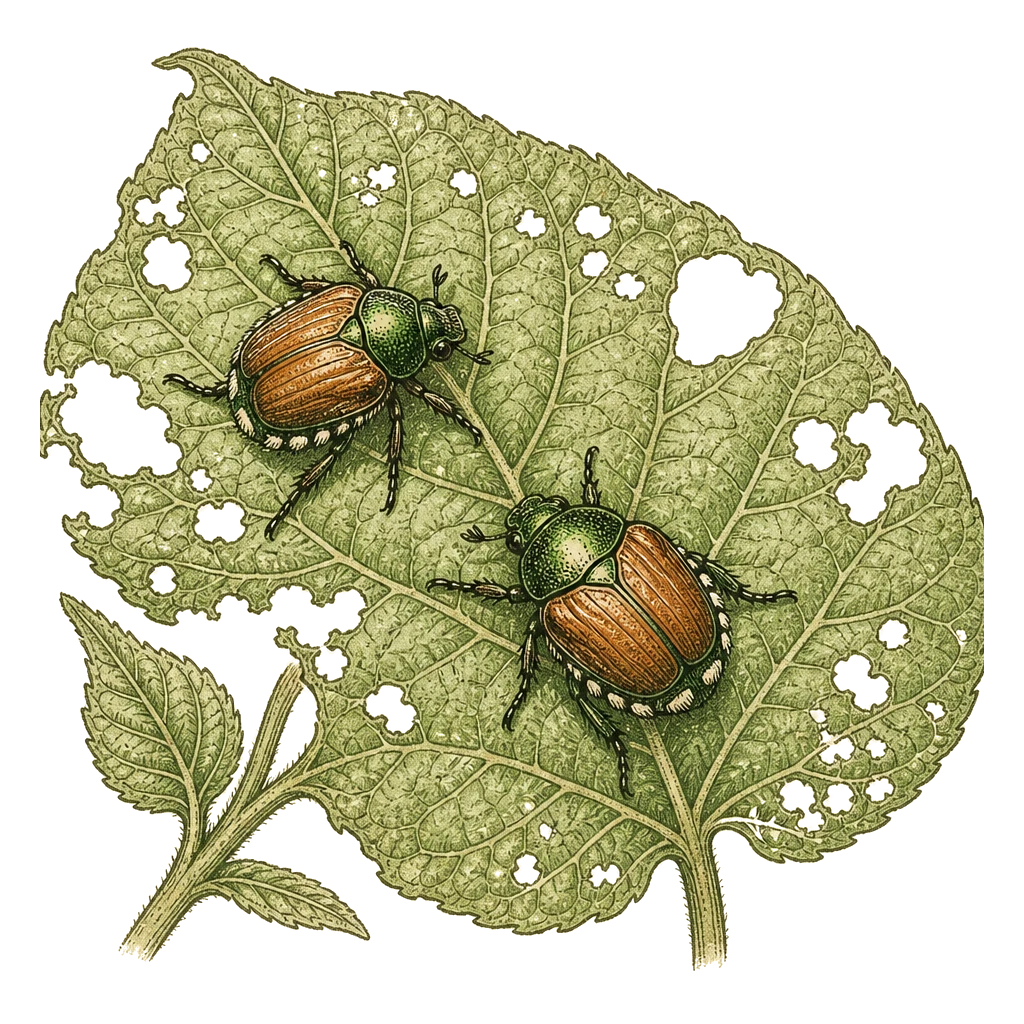
Japanese beetles are easy to identify and hard to ignore: metallic green head, copper-brown wing covers, roughly ½ inch long, often clustered in groups on the same plant. The fastest fix for a small infestation is handpicking — drop them into soapy water in the early morning or evening when they’re cool and sluggish. For larger pressure or high-value crops, row cover is the most reliable tool you have. For plantings too large to cover, targeted insecticides reduce pressure while beetles are active.
What’s actually happening
Adults feed on over 350 plant species, but in the vegetable garden the most vulnerable crops are beans, corn, asparagus, and okra. The feeding pattern is distinctive: beetles eat the tissue between a leaf’s major veins, leaving a lace-like skeleton. Damaged leaves turn brown and drop. On corn, the bigger problem is silk feeding — beetles congregate on corn silk during pollination, and heavy feeding disrupts kernel set and reduces yield.
The active adult season runs about 6–8 weeks, from late June or early July through late August, with activity tapering into September. Peak feeding happens on warm, sunny afternoons. After that window, the damage is largely done for the year regardless of what you apply.
Eggs laid in July and August hatch in about 2 weeks. The larvae — white grubs that grow from roughly ⅛ inch to about 1 inch — feed on roots through fall, with peak root damage in September and October.
What to do
Row cover first. A nylon insect screen with mesh of ¼ inch or less, draped over the bed from late June through early September, physically excludes adults. University of Minnesota Extension calls this the most reliable vegetable-garden protection. Remove it for hand-pollinated crops when flowers open, or shake covered plants daily if they’re self-fertile.
Handpick for smaller plantings. Early morning or evening, when beetles are cool, they drop rather than fly. Hold a container of soapy water under the plant and knock them in. This works well for beans and individual plants but becomes impractical for a full row or large bed.
Insecticides, if you go that route. Pyrethroids give the longest residual protection, roughly 2–3 weeks. Chlorantraniliprole lasts 2–4 weeks and is somewhat gentler on beneficials. Carbaryl and acephate need reapplication every 1–2 weeks. Neem oil is shorter still — a few days at best. None of these prevent feeding entirely; they reduce beetle longevity on treated plants. On food crops, check each product’s label pre-harvest interval — the required wait between spraying and harvest — before you treat. It varies by product, and the label is the legal requirement.
For corn specifically, planting timing matters. University of Maryland Extension notes that early or late plantings can avoid the peak silk-feeding window entirely — a simpler fix than spraying.
If you log a beetle sighting in Arbor, it flags the pest as urgent and adds a row-cover or treatment task to your current week’s list based on which crops are affected.
Skip the pheromone traps. This is the most common mistake. University of Minnesota and Wisconsin Extension both warn that bait traps attract far more beetles than they catch. Placing one near your garden pulls in beetles from the surrounding area and increases damage. If a neighbor has one, position your row cover accordingly.
Zone and season notes
Japanese beetle is an eastern and midwestern pest. It was introduced to New Jersey around 1916 and has since spread across most states east of the Mississippi and into many Great Plains states. It has not established in the Pacific states as of 2026, so gardeners in California, Oregon, and Washington are unlikely to be dealing with this insect.
In most of the beetle’s range, adults are active from late June through late August, tapering into September. In warmer zones or hot summers, that tail runs longer. The 6–8 week adult window is consistent enough that if you protect crops through it, the season is effectively over.
Grub treatments follow a different calendar. Preventive products — soil-applied granules such as imidacloprid or chlorantraniliprole, worked in before eggs hatch — work best from mid-June to mid-July. Curative options, such as trichlorfon or entomopathogenic nematodes, are most effective from late July through mid-September, while grubs are still near the soil surface. Follow label rates. Once temperatures drop and grubs move deeper, these treatments have little effect.
Milky spore is marketed as an organic long-term grub solution, but modern university trials show limited and inconsistent effectiveness. The bacteria infects only 2–5% of grubs annually and takes 2–3 years to establish in the soil. Extension sources do not recommend it with confidence; for turf grub pressure, focus on curative treatment timing instead.
When to worry / when not to
Healthy turf can tolerate up to 10 grubs per square foot before showing visible root damage. Vegetable beds are more sensitive because plants are smaller, but moderate adult feeding on established plants rarely kills them — it weakens them and stresses fruit set. The crops that warrant the most urgency are corn (silk window is narrow) and beans (beetles often cluster heavily). A few beetles on tomato foliage is cosmetic; a colony on corn silk during pollination is a yield problem.
Natural parasites and pathogens kill 16–30% of adult beetles in some monitored locations — background suppression, but not enough to skip intervention in high-pressure years.
Sources
- University of Minnesota Extension — Japanese Beetles in Yards and Gardens
- University of Maryland Extension — Japanese Beetles on Vegetables
- Wisconsin Horticulture Extension — Japanese Beetle
- Penn State Extension — Japanese Beetles in the Home Garden
- University of Illinois Extension — Japanese Beetle Myth Information