
Why Are My Vegetables Wilting?
Wilting tells you something is wrong with water delivery — but not why. The cause could be drought, too much water, a soil-borne fungus, or a bacterial infection. Each one needs a different response, and some get worse if you treat them like the others. Check the soil and the plant’s symptom pattern before doing anything else.
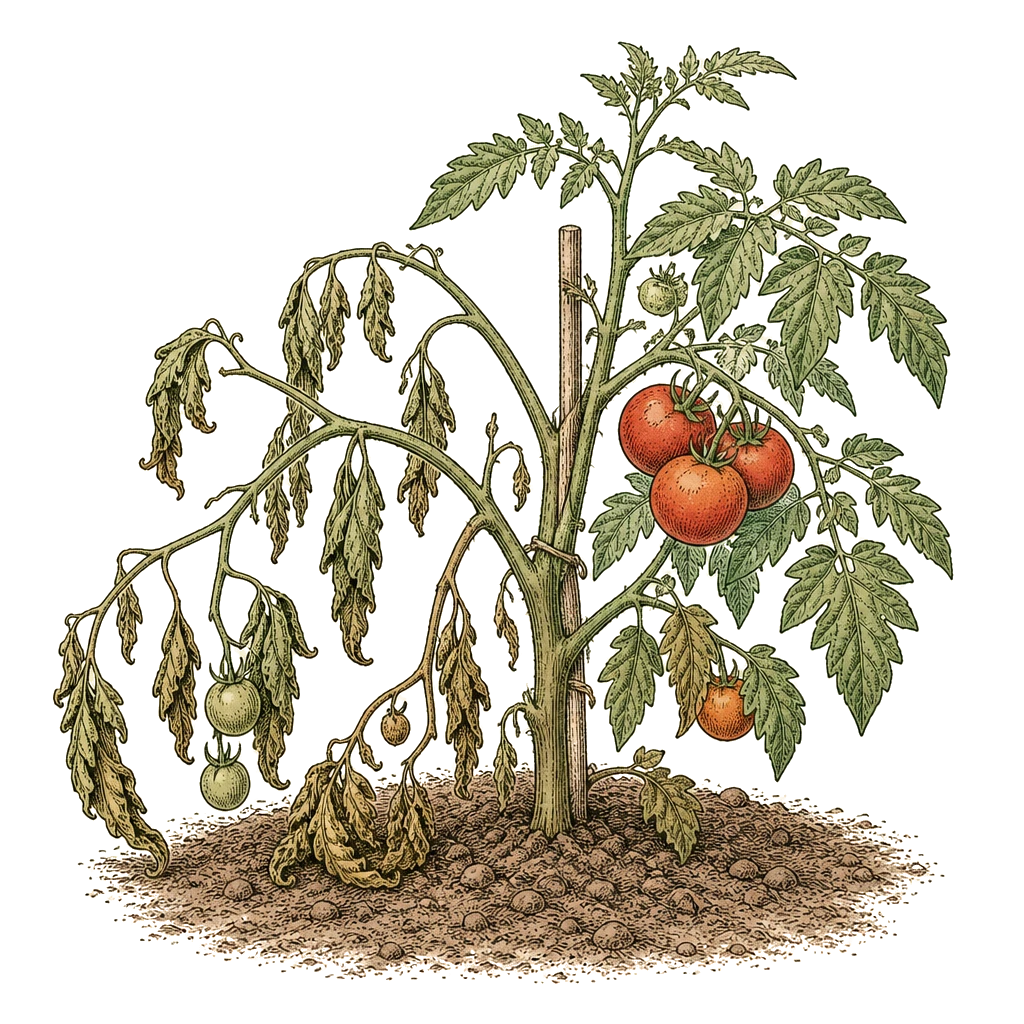
What’s actually happening
University of Maryland Extension explains the common thread: a plant wilts when its roots cannot supply sufficient moisture to stems and leaves. The root cause of that failure varies.
Temporary midday wilt on a hot day is often not a crisis. If the plant recovers by evening and the soil is adequately moist, it is a normal heat response — the plant simply cannot move water as fast as the sun pulls it out. Don’t reach for the hose until you check the soil. UMD notes that hot, drying winds trigger the same temporary wilt even when soil moisture is fine.
The two most common mistakes follow from misreading this: assuming midday wilt means drought, or assuming wilt with wet soil means thirst. Wilting with soggy soil almost always means the roots are oxygen-deprived from overwatering — they cannot take up water regardless of how much surrounds them.
What to do
Work through this in order.
Check the soil first. Dig a finger 2–3 inches into the root zone. Bone dry means drought; soggy days after the last rain means overwatering or root rot. If you find either, go to the overwatering vs. underwatering guide to diagnose further — and if the roots are already mushy or dark, check the root rot guide as well.
If the soil is fine and the plant droops only at midday, wait until evening. Recovery by sundown means heat response, not disease. No action needed beyond checking soil moisture the following morning.
Rapid, whole-plant collapse on cucumbers or squash calls for the stem-cut test. If the wilt is rapid and complete — the whole plant collapses, not just a branch — cut the stem near the base, press the cut ends together, and slowly pull them apart. Fine threads of bacterial ooze bridging the gap mean bacterial wilt, which is spread by cucumber beetles. There is no treatment; remove the plant. Cucumbers or squash already on the vine at the time of wilt are generally safe to eat — harvest any mature fruit before removing the plant, since the bacteria affect vascular transport, not the fruit tissue itself. The disease does not persist in soil, so your other cucumber or squash plants are at risk only if cucumber beetles keep feeding on them, which is why controlling the beetle is the prevention step. See the cucumber beetles guide for managing the vector.
If the wilt is one-sided or progresses from one branch, cut the lower stem and look at the cross-section. Brown or red streaking in the vascular tissue points to Fusarium or Verticillium wilt — both soil-borne diseases with no cure once infection takes hold. UMN Extension notes that Fusarium initially causes midday wilt with nighttime recovery, and yellowing is uneven, often limited to one side of the plant or one half of a compound leaf. Wisconsin Horticulture Extension describes Verticillium similarly: sudden yellowing that starts on one side, with brown streaking visible in the vascular tissue when you peel back the outer layers of an affected stem.
Remove affected plants. Do not compost them — bag and discard in household trash, since both Fusarium and Verticillium can survive composting and reinfect garden beds. For future seasons, UMN recommends rotating away from susceptible crops — tomato, eggplant, pepper — for 3–5 years or more to reduce Fusarium in soil, alongside weed management, since weeds can harbor the fungus. For resistant varieties: most seed catalogs indicate Fusarium resistance and which race the variety resists, and Wisconsin notes to watch for the letter “V” after a variety name for Verticillium resistance.
If you log a wilting plant in Arbor with notes on where the wilt is located, it flags which cause is most likely and adds a follow-up check to your task list for the next morning.
Zone and season notes
Midday heat wilt is most common in zones 8–11 and during summer heat waves anywhere. If you’re in a warm climate and wilt consistently appears between noon and 3 p.m. but disappears by evening, heat response is the likely explanation.
Fusarium wilt is favored by warm soil temperatures — UMN Extension notes the fungus thrives in warm soil, with an optimal temperature around 82°F, so it shows up mid-to-late summer in most zones. The Pacific Northwest and Mountain West carry V. dahliae broadly in garden soils, making Verticillium the more likely culprit in the cooler soils of those regions.
In cool, wet springs, wilting early in the season more often reflects cold, waterlogged soil after prolonged rain — the same oxygen-deprivation problem as overwatering, different trigger.
If wilting comes with yellowing, the yellow leaves guide covers the overlap between nutrient problems and disease symptoms.