
Growing Cantaloupe: Planting, Care, and Harvest
Cantaloupe needs about 80 days of frost-free warmth, full sun, and soil that stays above 65°F. One fact most growing guides undersell: the fruit stops developing the moment you pick it. A melon harvested at full slip — when the stem releases cleanly with a gentle tug — is sweeter than anything sold commercially. Miss that window and no amount of counter time recovers the flavor.
How it works
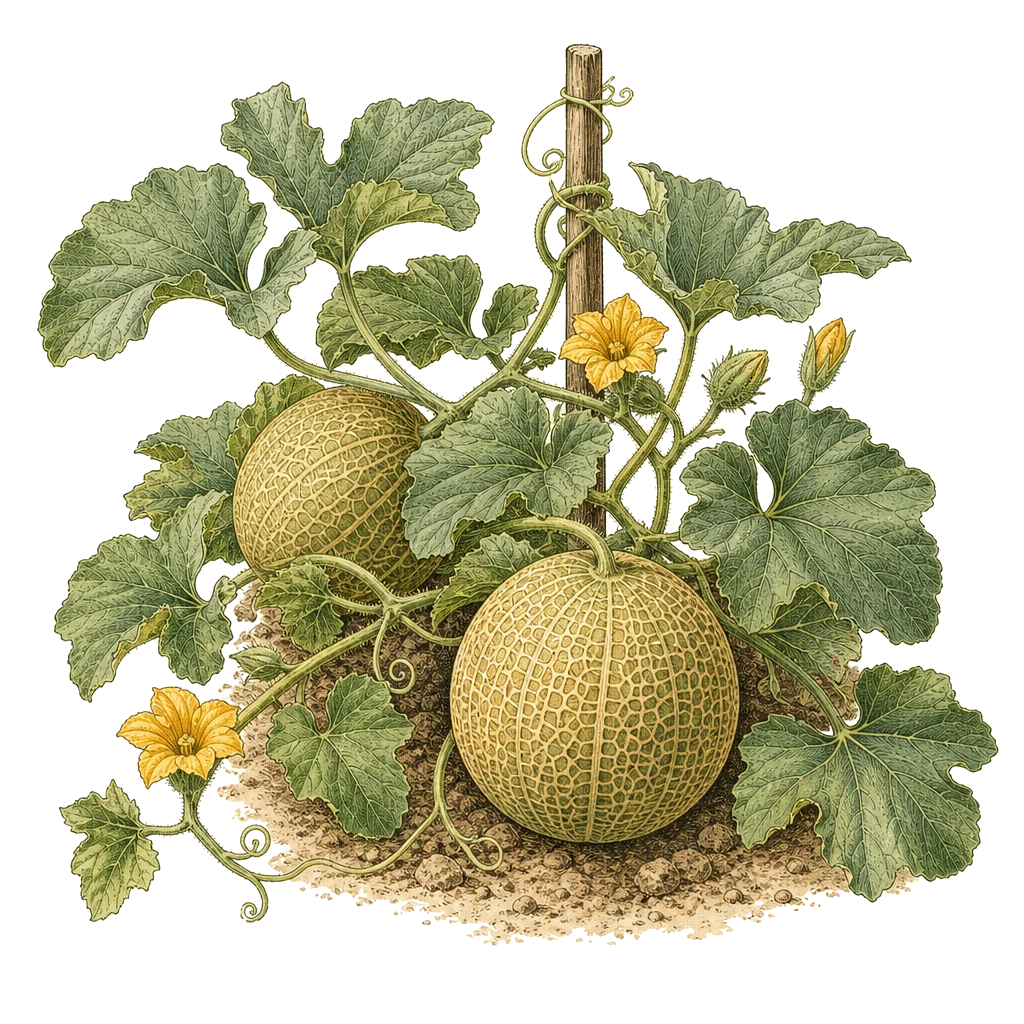
Cantaloupes are warm-season crops that will not tolerate frost. The plant dies at or below 33°F, and germination stalls below 65°F soil temperature. Flavor compounds — the sugars and aromatics that make a ripe cantaloupe worth growing — build during hot days and warm nights, with development peaking above 85°F.
Sugar concentration is the result of two linked processes. Through the growing season, the plant moves photosynthates down the vine into maturing fruit. In the final one to two weeks before harvest, water reduction concentrates those sugars further. Both processes stop when the stem’s abscission layer separates. This is why the common advice to “pick early and let it ripen on the counter” fails for muskmelons: no sugar builds once the fruit is off the vine.
Water management at the end of the season works the same logic in reverse. Utah State University Extension and the University of Maryland Extension both describe late-season irrigation reduction as the practice that separates a good cantaloupe from an excellent one. Consistent watering through vegetative growth is correct; pulling back in the final ripening window is what concentrates flavor. Overwatering at that stage dilutes it.
What to do
Planting. Wait until 2 weeks past your last frost date and, more critically, until soil temperature at 2-inch depth reaches 65°F. Direct sow seeds 1 to 2 inches deep, or set out transplants — both work. Space plants 24 inches apart in-row, with 5 to 6 feet between rows. Full sun is required throughout the season.
Vine management. Pinch out the growing tip of the main vine — the cluster of new leaves at the very end — once 5 to 6 leaves have opened below it, using your thumbnail or small scissors. This redirects energy into lateral branches, where fruit will set. Limit each plant to 3 to 4 fruit. More than that and the plant spreads resources too thin — the melons that result are smaller and less sweet. Three focused melons consistently outperform six underfed ones.
Fertilizing. Before planting, incorporate 1 to 2 pounds of 10-10-10 (or a balanced equivalent) per 100 square feet. When vines begin running, side-dress with nitrogen: about 3 to 4 tablespoons of a high-nitrogen fertilizer such as 21-0-0 per plant, worked into the soil and watered in. At fruit set, shift to a potassium-forward formula — potassium drives both fruit size and sugar accumulation during the final ripening phase. Clemson HGIC and Penn State Extension both describe this three-stage approach. Log the vine-running stage in Arbor and it prompts you to add the potassium-shift task and a water-reduction reminder for the final weeks before harvest.
Watering. Under normal conditions, water established plants every 3 days. Above 95°F, shorten to roughly every 2 days. Once fruit approaches full size — the final one to two weeks before harvest — cut irrigation back sharply; this concentrates sugar. Drip irrigation is preferable throughout because keeping foliage dry slows powdery mildew.
Pests and disease. Floating row covers from transplanting through first flowering block cucumber beetles, which transmit bacterial wilt — a disease that can kill plants within days and has no cure. Remove covers at first flower to allow bee pollination. After covers come off, check daily for striped or spotted yellow-green beetles on leaves and stems. For powdery mildew, the white powder on leaf surfaces that peaks in late summer when day-night temperature swings widen, adequate row spacing and dry foliage are the main defenses.
Harvest. Watch for four simultaneous signals: the rind develops coarse, raised netting; the background color shifts from green-gray to creamy tan or yellow; the blossom end yields slightly to thumb pressure; a sweet fragrance builds at the stem end. When all four align, tug gently at the stem. At full slip the fruit separates cleanly. Expect 35 to 45 days from pollination to harvest. Once any fruit shows early ripeness signs, check daily — the window from three-quarter slip to full slip is only a few days.
Zone and season notes
Zones 3 to 5 require extra setup. Start transplants indoors 3 weeks before last frost, and lay black plastic mulch before setting plants out: it raises soil temperature 5 to 10°F and can hasten maturity by 7 to 10 days, both significant advantages in a short season. Choose a short-season variety — Minnesota Midget (68 days) was developed by the University of Minnesota specifically for northern conditions. Floating row covers do double duty as frost protection and beetle barriers for the first weeks after transplanting.
Black plastic mulch still accelerates the early season in zones 6 and 7, but both direct sow and transplanting work well there without the short-season workarounds zones 3 to 5 require. Zones 8 to 10 can direct sow without any of these workarounds; cantaloupe’s drought tolerance and heat preference make it a better fit for dry, warm conditions than watermelon. Long-season gardens in California and Texas can fit two crops in a single year.
In cucumber beetle country — most of the country east of the Rockies — row covers are not optional regardless of zone. And in all zones, do not skip the water drawdown in the final stretch before harvest. That step is where flavor is made or lost.
Sources
- Utah State University Extension — How to Grow Cantaloupe (Muskmelon) in Your Garden
- University of Minnesota Extension — Growing Melons in the Home Garden
- Clemson HGIC — Cantaloupe & Honeydew Melons (HGIC 1339)
- Penn State Extension — Cantaloupe (Muskmelon) Production
- Iowa State University Extension — Growing Cantaloupe, Muskmelon, and Other Melons in the Home Garden
- Illinois Extension — Muskmelon
- University of Maryland Extension — Growing Melons in a Home Garden
- UC IPM — Cantaloupe