
How to Grow Onions
The single biggest decision in growing onions happens before you buy anything: choosing the right day-length type for your latitude. Onions form bulbs in response to how many hours of light they receive, not how many days they have been in the ground. Plant transplants into loose, well-drained soil when soil hits 50°F, water consistently at 1–1.5 inches per week, cut nitrogen once bulb shoulders push above the soil, and harvest when half the tops have fallen.
How it works
Onions fall into three photoperiod groups. Short-day varieties — Granex, Texas 1015Y Supersweet, Vidalia, Yellow Bermuda — begin bulbing when days reach 10–12 hours. They suit latitudes between roughly 25° and 35°N, where they grow as a cool-season winter or spring crop in mild climates. Long-day varieties — Walla Walla, Yellow Sweet Spanish, Copra — need 14–16 hours before they bulb, which only happens during summer in gardens north of about 37°N. Intermediate-day varieties split the difference at 12–14 hours and fit mid-latitudes from about 35° to 38°N.
The failure mode cuts both ways. A short-day variety planted in a northern spring will trigger bulbing before the plant has grown enough leaf mass to support a large bulb. A long-day variety grown in the deep South never encounters 14–16-hour days and never bulbs adequately before summer heat shuts it down.
Sets — small dormant bulbs sold by the bag — look like the easy option, but UNH Extension research finds that transplants consistently outperform them. Sets are prone to bolting, produce smaller bulbs, and can carry over disease. Use transplants — see how to transplant seedlings for technique.
What to do
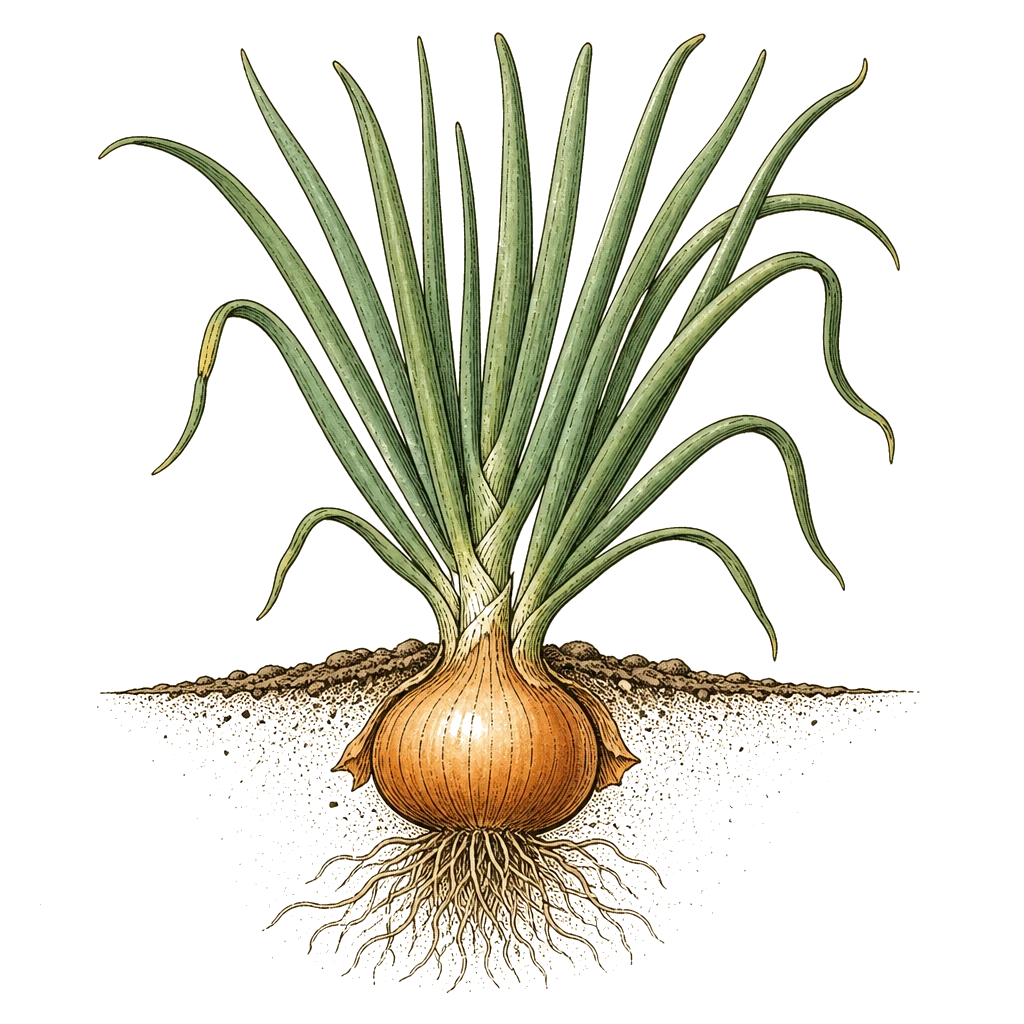
Before you plant, prepare a bed with loose, well-drained soil — onions rot in standing water and their shallow roots can’t penetrate compacted ground. If your soil is heavy or clay-rich, work 2–3 inches of compost into the top 6 inches before setting transplants.
Plant transplants when soil temperature reaches 50°F. Set them 1–1.5 inches deep, spaced 4–5 inches apart in rows 12–18 inches apart; the wider end of that spacing — 5 inches — favors larger bulb development. Transplants tolerate light frost, but tissue damage begins at 28°F. If you started from seed indoors, sow 10–15 weeks before your last frost date; trim roots to 1/2 inch and tops to 4 inches right before setting plants out — this reduces transplant shock and encourages new root growth.
Keep the bed weed-free from planting through harvest. Onions can’t shade out competition, and even moderate weed pressure significantly reduces bulb size. Cultivate shallowly — no deeper than 1 inch — to avoid disturbing the shallow root system. Once transplants are established, a light straw mulch between rows handles much of the work.
Onions have shallow root systems and can’t pull moisture from depth — they need 1–1.5 inches per week throughout the season. During the final 3–4 weeks of bulb swell, push to 1.25–1.5 inches per week under hot or dry conditions. Stop watering 1–2 weeks before harvest, once tops begin to fall naturally — continuing to irrigate at that stage softens bulbs and cuts their storage life.
Fertilize in two stages. Before planting, apply a balanced fertilizer (10-10-10) in a narrow strip 2–3 inches to the side of the transplant row at the package rate — this concentrates nutrients where roots will reach without burning transplants. Once tops reach 6 inches tall, side-dress with urea (45-0-0) at 0.25–0.5 lb per 25 feet of row; repeat 4 weeks later if growth is slow. Then stop. The signal is visible: when bulb shoulders start to push above the soil line and the leaf count stabilizes, applying more nitrogen drives oversized necks, soft flesh, and poor storage quality. When you log your planting date in Arbor, it schedules nitrogen side-dressing reminders timed to that 6-inch benchmark and flags the cutoff as bulbing approaches.
Harvest when 50–80% of the tops have fallen over on their own. Undercut bulbs with a spading fork rather than pulling straight up — pulling tears the neck and creates an entry point for rot. Cure in a warm spot (75–90°F) with good airflow for 2–4 weeks, until the outer skins are papery dry and the necks are tight.
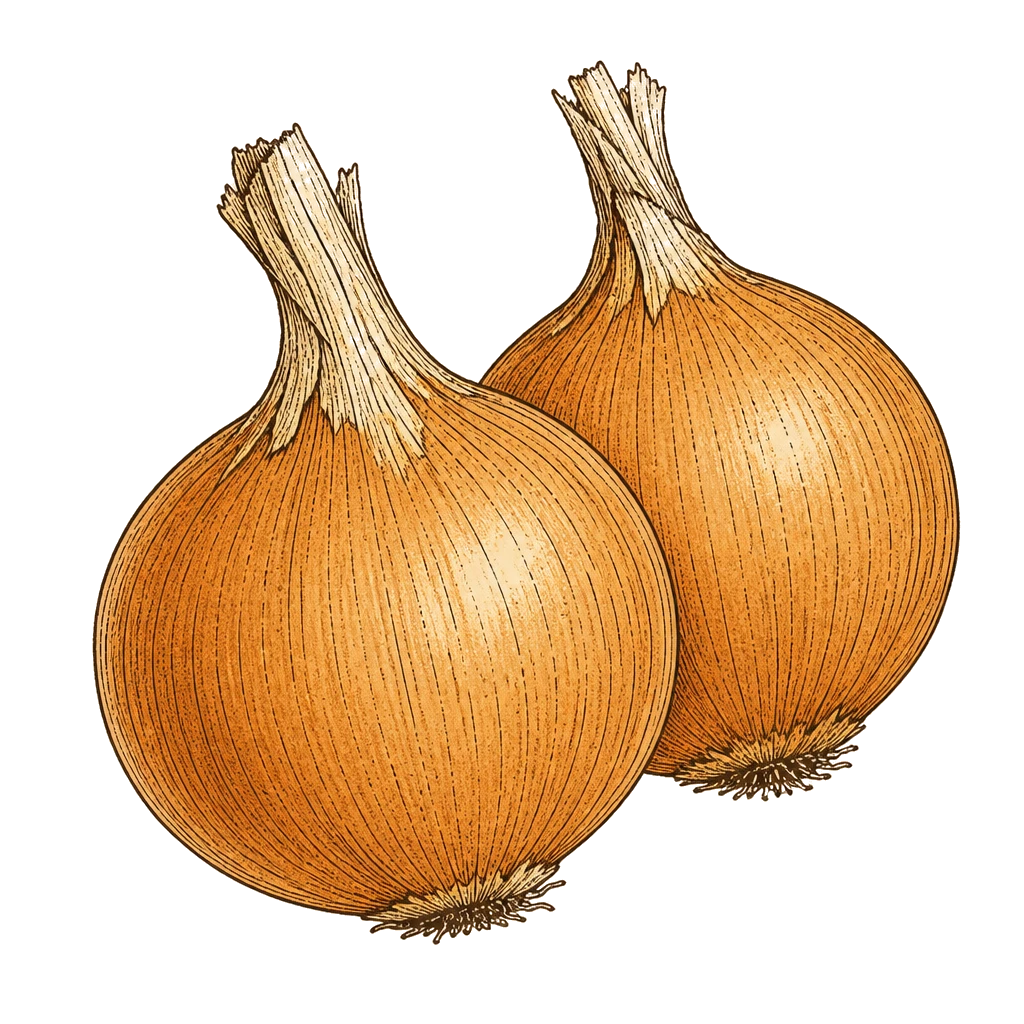
Cured pungent long-day varieties hold up to a year at 32–40°F with 60–70% humidity in mesh bags or slatted crates. Sweet short-day types store only 4–6 months even when perfectly cured — use them first.
Zone and season notes
Zone 3–6 (North): Long-day varieties only. Set transplants 4–6 weeks before your last frost date — typically March or April — and expect harvest in July or August, around 110 days after transplanting.
Zone 7 (mid-Atlantic, transitional): Intermediate-day varieties are the best default for spring planting; long-day types also work. In mild Zone 7 winters where temperatures rarely drop below 28°F for extended periods, short-day varieties can be grown as a fall crop — plant October through November for a May harvest — but a sustained hard freeze will damage exposed bulbs.
Zone 8–9 (South, fall planting): Short-day varieties — Granex, Texas 1015Y — go in October through February and come out May through June before summer heat sets in. Plant when days are short and let bulbing happen in spring as daylength climbs toward 10–12 hours.
Zone 10–11 (subtropical): Daylength never reliably reaches the 14–16-hour threshold for long-day types. Grow short-day varieties only, with fall or early-winter planting.
Sources
- UMN Extension — Growing Onions in Home Gardens
- UMD Extension — Growing Onions in a Home Garden
- USU Extension — How to Grow Onions in Your Garden
- Texas A&M AgriLife Extension — Onions
- Nebraska Extension (Lancaster Co.) — Onions: Long Day, Short Day or Neutral?
- UNH Extension — Is it better to grow onions from seeds, sets or transplants?
- Illinois Extension — Onion
- UC IPM — Cultural Tips for Growing Onions and Garlic