
When to Plant Vegetables by Frost Date
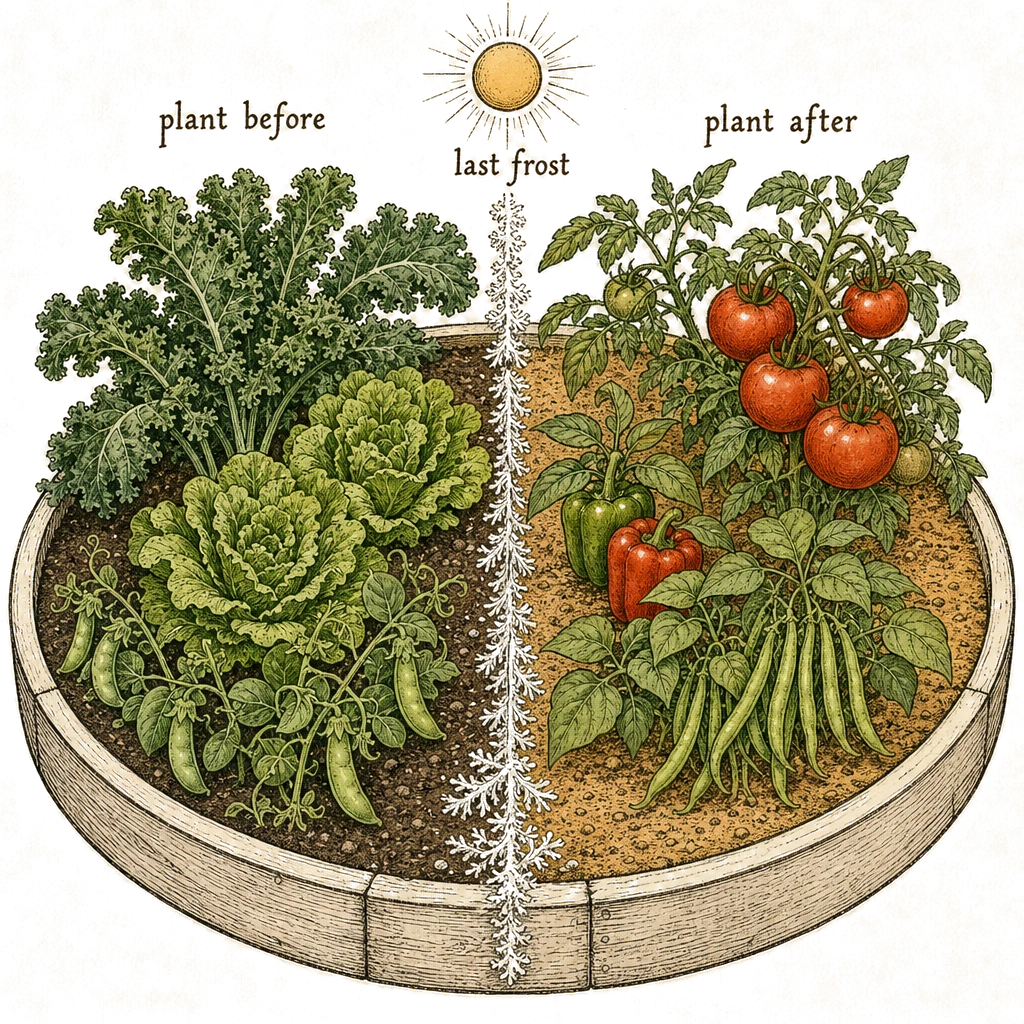
A USDA hardiness zone tells you how cold your winters get, not when to plant. Plant in four waves counted from your own average last frost: hardy crops 2–4 weeks before it, semi-hardy 0–2 weeks before, tender at the date itself, very tender 2 or more weeks after. The zone number can’t tell you any of that — it measures average annual extreme minimum winter temperature, nothing about your last spring frost, first fall frost, or the days between them.
How it works
The map sorts the country into 10°F bands and 5°F half-zones, numbered 1a through 13b, and answers exactly one question: which perennials survive a winter in this spot. Growing-season length is a different measurement — the days between your average last spring frost and average first fall frost — and it’s the number that actually decides what finishes in your garden. A 120-day tomato planted into a 100-day season freezes before it fruits, no matter how mild the zone rating looks. Two gardens can share a zone number and still run seasons weeks apart. That’s also the number worth checking before you buy seed: a variety’s days-to-maturity, right on the packet, only works if it’s shorter than your season. Several growing guides flag which varieties run short or long for exactly this reason — growing tomatoes lists which ones finish fast enough for a tight season.
What to do
Get your own frost dates before you use anything below — every date here is counted from them, and yours can run weeks off a zone average. Purdue’s Freeze Date Tool and the National Gardening Association’s frost-date finder both work from a zip code and give a real local figure in under a minute. Treat what comes back as a median, not a guarantee: frost can land later than the date on the page, which is why the waves below are windows, not single days.
Vegetables fall into four cold-hardiness groups, sorted by university-run gardening research — the same free, science-based guidance a county agent would hand you — and each group goes in on its own schedule, counted in weeks from your last-frost date. Those four groups collapse into two underlying categories, cool-season and warm-season, which is why some of these crops get a second planting window in fall and others get exactly one:
| Group | When to plant | Daytime temps | Crops |
|---|---|---|---|
| Hardy | 2–4 weeks before last frost | as low as 40°F | broccoli, cabbage, kale, kohlrabi, onions, lettuce, peas, radish, spinach, turnips |
| Semi-hardy | 0–2 weeks before last frost | 40–50°F | beets, carrots, cauliflower, parsley, parsnips, potatoes, Swiss chard |
| Tender | around the last frost date | above 55°F | bush beans and trellised pole beans, celery, corn, cucumbers, summer squash |
| Very tender | 2+ weeks after last frost | above 60°F, best 70–95°F | lima beans, cantaloupe, eggplant, okra, pepper, pumpkin, sweet potatoes, tomatillos, winter squash, tomato, watermelon |
Those are outdoor dates — sown straight into the bed, or set out as transplants started indoors earlier. Start indoor trays 6 to 8 weeks before you plan to move them outside; for a very tender crop set out two weeks after last frost, that puts trays 4 to 6 weeks before last frost, not at it.
A single week of daytime temperatures below 55°F can stunt a very tender crop even after its window opens, so a late cold snap is worth waiting out. An early hardy sowing that gets frosted is a cheap mistake; an early tomato is an expensive one.
Soil temperature is the better check than any date. Plant once the soil holds a crop’s minimum at an 8 a.m. reading, 4 inches deep for most crops and 6 inches for beans; save the higher, optimum figure for a seed tray indoors, where you control the temperature. Minimums vary by crop: lettuce germinates down to 35°F but fastest near 75°F, tomato needs at least 50°F and germinates fastest near 85°F, corn shares that 50°F minimum but is fastest near 95°F, watermelon needs 60°F, and okra and sweet potatoes want 65°F. See how to start seeds indoors for trays, or how to direct-sow vegetable seeds for the bed — or the full spring sequence bed prep through transplant.
Running those offsets for a dozen crops is the tedious part. Arbor asks for your zip code at setup, resolves your zone, and schedules each crop from frost dates where winters freeze hard, or from the cool- and warm-season windows where they barely do — then adds the tasks when you confirm the plan.
Zone and season notes
A single state can span nearly a month of frost dates on its own — the gap between its northern and southern counties can rival the gap between two zones. Wind, elevation, and proximity to buildings or water move a garden’s microclimate independent of any zone map. Zone-by-zone calendars work the four waves out against each zone’s own frost window, and zones 3 through 8 all have one now, so use yours rather than running the offsets by hand. Zone 9 splits into a colder 9a and a milder 9b, about a week apart on frost timing. This method assumes a defined frost season. Zone 10 and warmer work differently: 10a keeps a nominal frost date, 10b has none at all, and the cool-season window moves into fall and winter instead.
If the spring window has already closed where you are, run the same arithmetic backward from your average first frost date instead — Fall Vegetable Planting covers the full backward-count method and its own buffer for slower fall growth. Central Maryland runs an October 25 first frost; central Pennsylvania’s University Park campus runs closer to October 12 — one more reminder of how much that date can move inside a single state.
Seedlings started for a fall crop go out at the same stage they would in spring — see how to transplant seedlings.
Sources
- USDA Agricultural Research Service — USDA Plant Hardiness Zone Map (2023)
- University of Vermont Extension — USDA Hardiness Zones
- Colorado State University Extension — CMG GardenNotes #720: Vegetable Planting Guide
- Illinois Extension — When to Plant (Home Vegetable Gardening)
- Illinois Extension (ILRiverHort) — Time Your Vegetable Plantings by Cold Hardiness
- Alabama Cooperative Extension System — Soil Temperature Conditions for Vegetable Seed Germination
- University of Maryland Extension — When to Plant Vegetables
- NC State Extension — Central North Carolina Planting Calendar for Annual Vegetables, Fruits, and Herbs
- Penn State Extension — Season Extenders and Growing Fall Vegetables