
How to Grow Zucchini
Zucchini reaches first harvest around 50 days after planting and will outproduce almost any other vegetable in your garden — if you harvest at 6–8 inches and keep up every other day. Let a fruit go unnoticed past that size and the plant reads it as a signal to stop producing new ones. That single habit explains most “my zucchini stopped fruiting” complaints.
How it works
Zucchini is a warm-season crop that stalls and rots in cold soil. Do not plant until after your last frost date and soil temperatures reach at least 60°F — germination is poor below that threshold and seeds often rot before sprouting. University of Minnesota Extension targets 70°F at 2-inch depth for reliable germination. Both direct sow and transplants go out 2 weeks after last frost; if you start transplants indoors, sow seeds 3 weeks before that outdoor date. Zucchini roots are sensitive, so long indoor periods produce root-bound plants that set back badly at transplanting.
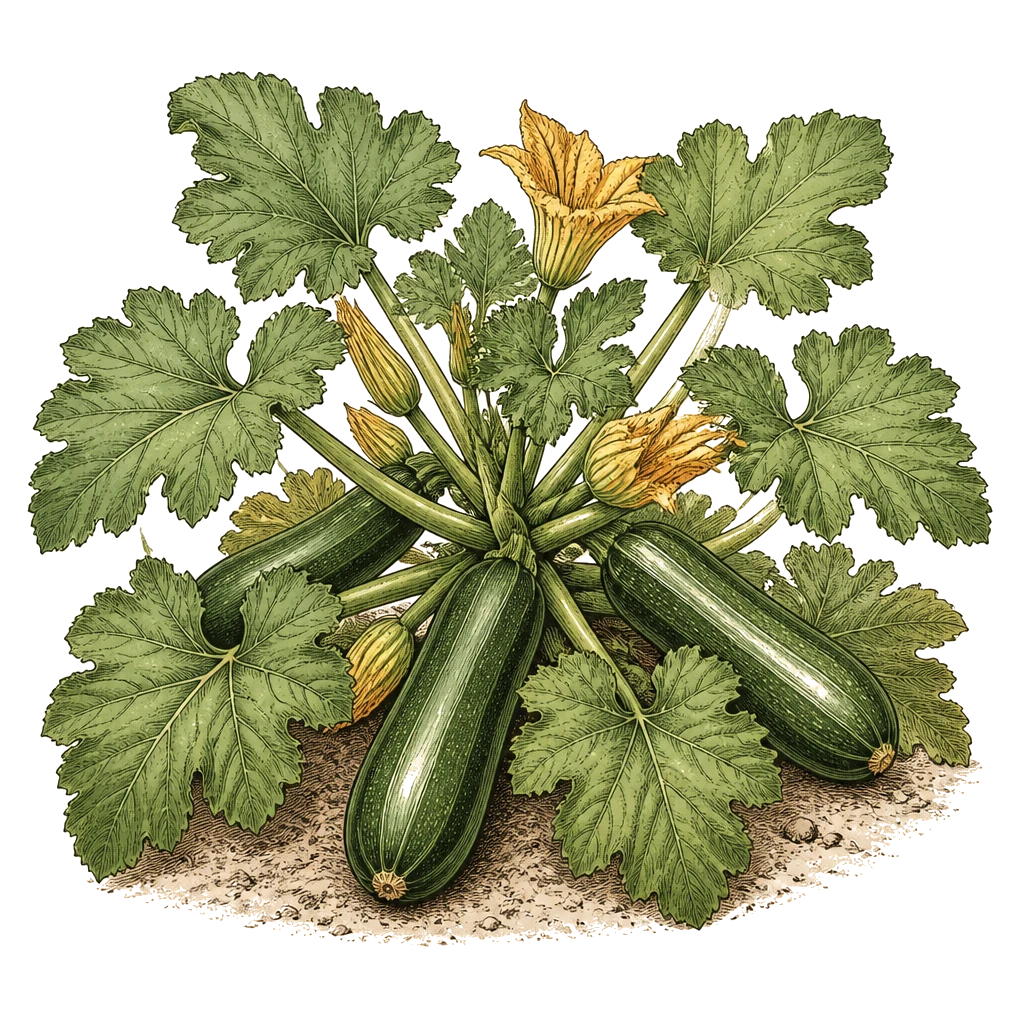
Separate male and female flowers appear on the same stem, with males arriving 1–2 weeks before females — this is normal sequencing, not a sign of trouble. Female flowers carry a small round immature fruit at the base; male flowers have a plain slender stem. Squash blooms are open for only one day and close by evening. When pollination doesn’t happen — because of rain, cold, heat, or pesticide residue — small fruits drop or grow deformed. Deformed fruit means incomplete pollination, not a soil or nutrient problem.
Wet leaves are the fastest route to powdery mildew, which appears as white powdery spots on leaf surfaces and spreads rapidly in warm, humid canopy conditions. Water at the base only, never overhead — soaker hoses or drip eliminate the risk.
What to do
Site and soil. Zucchini needs full sun — at least 6 hours, with 8 or more preferred. Target a soil pH of 6.0–6.5 in well-drained, moisture-retentive ground. Before planting, work in 2 inches of compost or apply 4–6 cups of 10-10-10 fertilizer per 100 square feet.
Planting. For direct sowing, plant seeds 0.5 inch deep and sow 4–6 seeds per hill or station, then thin to the 1–2 strongest plants after emergence — cut at soil level with scissors rather than pulling, which disturbs neighboring roots. Space bush-type plants 24 inches apart in rows 3–5 feet apart. When starting transplants, harden them off before moving outdoors.
Watering. Provide 1–2 inches of water per week, soaking to at least 6 inches of soil depth. Established plants in warm conditions typically need watering every 3 days. Water at the base — soaker hoses and drip are ideal; overhead sprinklers promote powdery mildew. Water in the morning; evening watering leaves foliage wet overnight, which accelerates powdery mildew. As fruits ripen in late summer, reduce water slightly to prevent rots.
Fertilizing. Once female flowers first appear and vines begin to spread, side-dress with 3–4 tablespoons of 21-0-0 ammonium nitrate per plant. Avoid excess nitrogen at this stage — it pushes leafy growth at the expense of fruit and worsens aphid pressure.
Pollination. During cool or rainy stretches when bee activity drops, hand-pollinate to keep fruit setting. Take a freshly opened male flower, remove the petals to expose the anther, and touch it directly to the stigma of an open female flower. Do this in the morning while both are open. One male flower can pollinate several females. Avoid pesticides during bloom — even organic products kill the pollinators you need.
When you log your first open female flower in Arbor, it queues the side-dress nitrogen task and the row-cover removal (if you used covers for pest protection) on the same week’s list, since both jobs key off that date.
Managing squash vine borers. Larvae bore into the vine base and cause sudden, complete wilting; greenish or orange sawdust-like frass at stem-base holes is the tell. In northern states, adults lay eggs from mid-June through July; in the Southeast (zones 7–9), a second generation is active from late July into August. Two strategies work without sprays: use row covers over seedlings and remove them at first flowering, or plant a succession crop in mid-July to dodge both egg-laying waves. For active infestations, slit the vine, remove larvae, and cover the wound with moist soil to encourage new roots. If physical removal is not feasible or the infestation is severe, apply carbaryl or permethrin to stem bases at 7–10 day intervals; two applications are typically sufficient.
Managing squash bugs. Adults overwinter in debris and lay golden, oval egg clusters on leaf undersides when vines begin running. Nymphs hatch 1–2 weeks later; their feeding injects a toxin that blackens and dries out vines — a pattern that mimics bacterial wilt. Check leaf undersides early and remove egg-bearing leaves before they hatch. Hand-remove adults and use row covers until plants begin flowering.
Harvest. Check plants daily or every other day once fruit sets. Pick at 6–8 inches long and about 1.5–2 inches in diameter, while skin is still tender. Do not harvest when vines are wet. Any oversized fruit left on the vine suppresses further production — remove it even if you can’t use it. Fruit that formed before pest damage is safe to eat; discard any with soft spots, borer wounds, or rot. Fresh zucchini stores in the refrigerator for up to a week; University of Maryland Extension puts the range at 5–14 days at 32–50°F.
Zone and season notes
Northern tier (zones 3–5, Minnesota and similar). Direct sow in late May, or early June in the northernmost areas. Vine borers complete one generation per year, and a succession sowing in early July sidesteps the peak egg-laying window.
Mid-Atlantic (zones 6–7). A second crop planted July 1–15 extends harvest into fall and dodges vine borer pressure.
Southeast and Carolinas (zones 7–9). Vine borers complete two generations per year; second-generation larvae emerge in August. Striped cucumber beetles also run two generations and transmit bacterial wilt — managing beetles early is the most direct control for that disease.
Mountain West (zones 4–7, Utah and similar). Water 1–2 inches per week; dry Western air pulls moisture from soil faster than humid-region norms. Drip irrigation is especially practical. Wait for confirmed soil temperatures before seeding — cold planting is the most common cause of poor germination.
All regions. Do not plant when soil is below 60°F. Powdery mildew peaks in warm weather with poor airflow, so remove old lower leaves and hold 24-inch spacing. Fungicide at the first white spots, repeated every 7–10 days, slows spread; sulfur-based products should not be applied above 80°F.
Sources
- University of Maryland Extension — Growing Summer Squash (Zucchini) in a Home Garden
- University of Maryland Extension — Key to Common Problems of Squash
- University of Maryland Extension — Pollination Problems of Vegetables
- University of Minnesota Extension — Growing Summer Squash and Zucchini in Home Gardens
- University of Minnesota Extension — Squash Vine Borers
- Utah State University Extension — How to Grow Summer and Winter Squash in Your Garden
- Utah State University Extension — Powdery Mildew on Vegetables
- Clemson Cooperative Extension HGIC — Summer Squash
- NC State Extension — Insect and Related Pests of Vegetables: Pests of Cucurbits