
Cool-Season vs. Warm-Season Crops, Explained
Cool-season and warm-season aren’t a sliding scale of cold tolerance — they’re two different requirements. A cool-season crop needs cold to germinate, grow, and mature, not just to survive it; a warm-season crop needs sustained warmth in both the soil and the air, and stalls once nights turn cool, even if the days still feel warm. That distinction is also why some cool-season crops get two real growing windows in a year, spring and fall, while every warm-season crop gets exactly one.
How it works
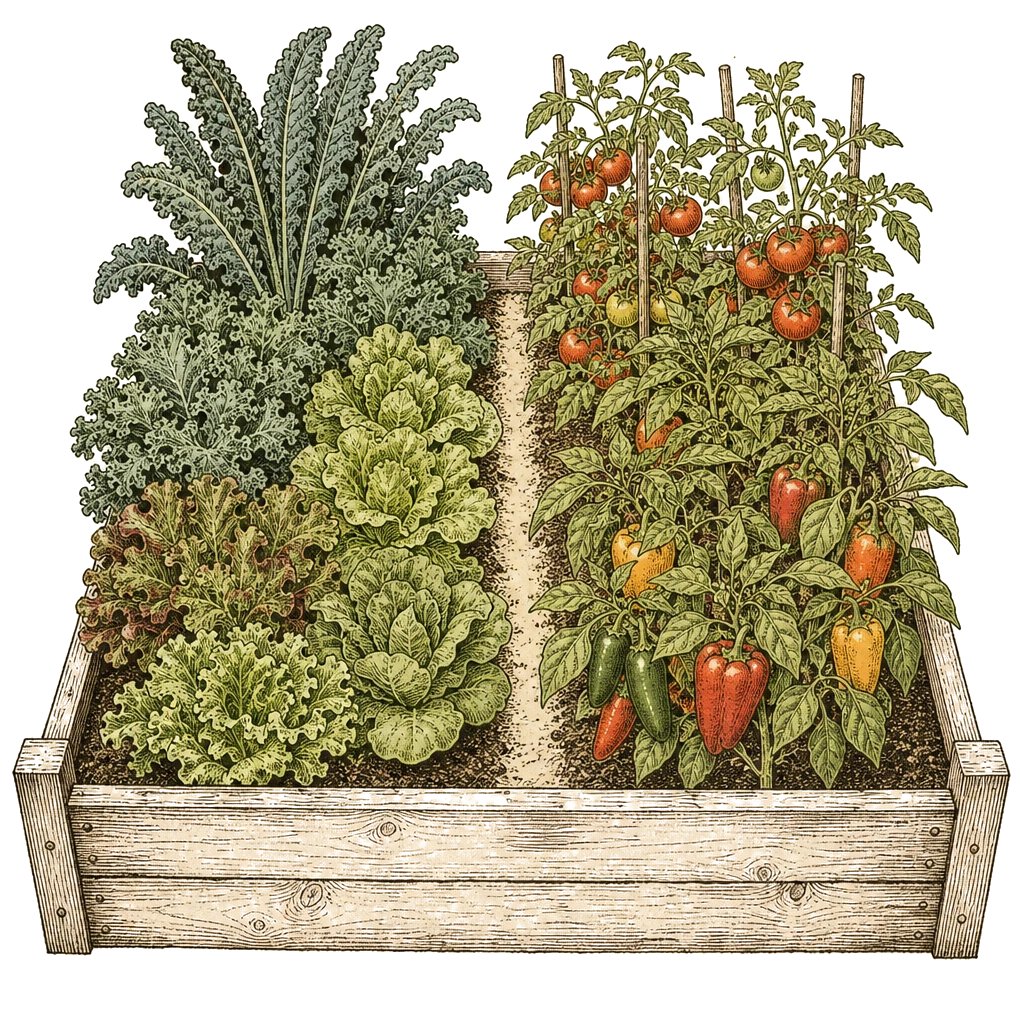
The cool-season group is roots and leaves: beets, carrots, parsnips, radishes and turnips; the brassicas, broccoli through kale; lettuce, spinach and Swiss chard; peas, onions and chives. Every one of them completes germination, vegetative growth and fruit set under cold conditions, not despite them. Warm-season crops — tomatoes, peppers and eggplant, beans and corn, sweet potatoes, and the vine crops from cucumbers to watermelon — need higher soil and air temperatures for those same stages, and go in only after the last frost date. The real dividing line isn’t “handles frost” versus “doesn’t”; it’s “requires cold” versus “requires heat.”
For crops like broccoli, lettuce, and spinach, the ideal range for that first month of growth sits in the 50s and 60s°F: cool enough to grow well, warm enough that the plant keeps making leaves instead of reading the cold as its cue to turn reproductive. That switch into the reproductive stage comes first, and bolting is what follows it. Heat and longer days then speed the flowering up — they accelerate a process already under way rather than starting it. A bolting plant is moving into seed production, not failing or getting sick.
Lettuce shows the range concretely. NC State Extension’s crop guide puts optimal vegetative growth at 60–65°F. Seed germinates down to 35°F and fastest near 70–75°F, and many modern cultivars tolerate short daytime stretches of 80–85°F as long as soil moisture holds and nights stay cool. Hardened lettuce plants also tolerate light freezing; repeated or prolonged exposure below freezing still causes real injury or crop loss.
What to do
Use the category, not just a date on a calendar, to plan the season’s structure. Beets, carrots, parsnips, radishes, turnips, peas, onions, lettuce, spinach, and Swiss chard go straight into the bed, and most go in twice: once in spring for a crop that finishes before summer heat pushes it toward bolting, and again in late summer for a fall crop that matures as the weather cools back down. The brassicas are cool-season on the same terms but sown differently — broccoli, cabbage, cauliflower, and kale start indoors and go out as young transplants. Chives sit outside the pattern: a cold-hardy perennial, planted once and cut for years rather than resown each season.
The warm side splits the same way. Beans and corn go straight into warm soil, since neither transplants well; tomatoes, peppers, eggplant, and sweet potatoes are set out as transplants; cucumbers, zucchini and other summer squash, winter squash, cantaloupe, and watermelon work either way. All of them get one cycle: planted after your last frost date, harvested through late summer. When to plant vegetables gives that date for your zone.
Watch the overnight low as closely as the daytime high once a warm-season crop’s window is open. A run of cool nights closes that window even when the afternoons still read warm, so the overnight number decides the planting date more than the calendar does.
Zone and season notes
The two-category split itself doesn’t change by zone — cool-season crops need cold everywhere, warm-season crops need heat everywhere. What changes is which of a cool-season crop’s two windows actually carries the season. In warm-winter zones, cool-season crops can run through fall and winter as the primary crop rather than a bookend to summer. In cold-winter zones, both cool-season windows have to fit into spring and fall around a warm-season summer core — the four-wave structure when-to-plant-vegetables lays out crop by crop, with zone-specific frost dates. Add spinach to a bed in Arbor and it schedules the sowing counted back from first frost where winters freeze hard, or at the start of the cool planting window where they barely do; add tomatoes to the same bed and the date comes off last frost, or off the warm planting window.
For the spring window itself, spring vegetable planting covers bed prep and timing; for the fall repeat, fall vegetable planting covers counting backward from first frost, with its own buffer for slower fall growth. Gardeners stacking more than one cool-season sowing inside a single window should see succession planting for spacing those out.