
How to Prune Vegetable Plants
Most vegetables don’t need routine pruning. Beans, squash, and cucumbers are left alone by extension programs — there’s no consistent evidence that removing their growth improves yield. Indeterminate tomatoes are the exception. They keep growing until frost, and without weekly attention the plants become unruly, disease-prone, and harder to harvest. The pruning work that matters is almost entirely on this one crop. If you landed here from a task on a bean, squash, or cucumber, the intended action is removing dead or yellowing leaves — not structural pruning — and no further technique is needed.
How it works
The key word with tomatoes is indeterminate. Indeterminate varieties keep setting new flowers and fruit continuously throughout the season rather than ripening one main flush and stopping. Determinate varieties — sometimes called “bush” tomatoes — stop growing when they set a terminal bud, typically around 4 feet tall, and concentrate their harvest into a short window. Pruning strategy depends entirely on which type you’re growing.
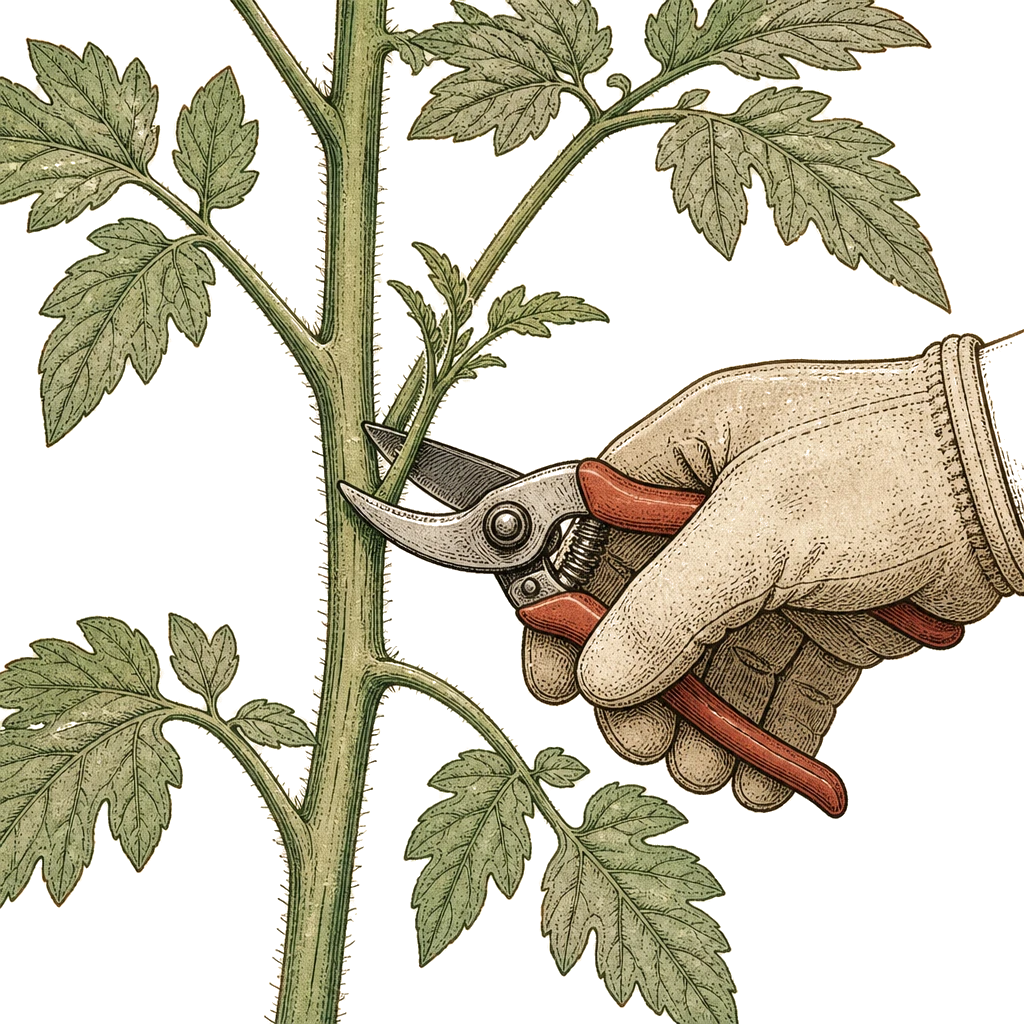
Indeterminate tomatoes produce suckers at every leaf axil — the junction between each leaf and the main stem. Left to grow, each sucker becomes a full branch with its own suckers, and the plant sprawls. UNH Extension recommends pruning to 1 or 2 main stems, with a single leader the most common approach. For a single-stem plant, remove every sucker as it appears. For two stems, save the first sucker that forms just below the first flower cluster and remove all others. Either way, the work repeats weekly during active growth.
Determinate tomatoes should not be suckered heavily. Because they set fruit once in a compact habit, aggressive pruning removes the side growth that carries their harvest. If you’re growing a determinate variety, train it to a cage and let it fill out.
For indeterminate tomatoes in a cage, Clemson Extension recommends pruning once to 3 or 4 main stems rather than the weekly single- or two-stem routine. The denser foliage inside a cage also provides useful shading that reduces sunscald on developing fruit — another reason not to strip a caged plant to a single stem.
What to do
Start by confirming your variety type. Seed packets and transplant tags typically say indeterminate or determinate; if it’s unlabeled, look it up by name. If the tag is gone and you can’t identify the variety, watch the plant: indeterminate vines keep growing past the top of any support with no natural stopping point, while determinates stop climbing and bush out once they reach roughly 3 to 4 feet.
For indeterminate tomatoes trained to stakes or a Florida weave trellis, check plants every 7 days during the growing season. Snap off suckers by hand when they’re small — under an inch or two — using a sharp downward motion at the base. For larger suckers, use clean pruning shears rather than tearing by hand, which leaves a larger wound.
Staking setup matters as much as the pruning itself. Clemson recommends 6-foot stakes that are 1.5 to 2 inches wide, driven 1 foot into the soil about 4 to 6 inches from each plant. Tie the main stem to the stake with twine or cloth strips every 10 inches of height as the plant grows. The Florida weave — running twine lengthwise between stakes with the twine looped around each stake — follows the same 10-inch interval and is common for in-ground rows.
Determinate varieties and any caged tomato need far less management: prune to 3 or 4 main stems at the start of the season and otherwise let the plant fill the cage. Check occasionally to remove stems pushing outside the cage structure.
Peppers and eggplant are a separate case. Extension guidance for them differs from tomatoes: they don’t need the weekly suckering routine at all. Specific published pruning protocols for these crops were not found in the sources for this article, so limit yourself to removing the first flower bud from young transplants so the plant puts energy into growth before fruiting, and thinning crowded interior growth if airflow is poor. Beyond that, leave them alone.
Keeping stems off the soil is non-negotiable for all tomato types. UNH Extension notes that contact with the ground is a direct route to fungal diseases including early blight, Septoria leaf spot, and anthracnose. When Arbor adds a prune task to your weekly list, check whether suckers have appeared at the leaf axils. If none are visible yet, the task can wait a few days; once you see them, remove them while they’re still under an inch.
Zone and season notes
In warm-winter zones (9–11), indeterminate tomatoes are the better choice. Clemson Extension notes that determinate varieties are unsuitable for extended warm seasons — they flush and decline while indeterminate plants keep producing. If you’re in a zone where summer stretches past what cool-season crops can handle, indeterminate varieties paired with regular suckering give you a productive window from late spring through early fall.
Short-season cold climates are where determinate varieties earn their keep: some gardeners choose them to get a concentrated yield before frost closes the season. If you go that route, skip the weekly suckering routine — you’ll harvest fewer tomatoes, not more, by removing side growth from a plant that’s already on a tight timeline.