How to Grow Basil: Planting, Pinching, and Harvest
Two things knock out most home basil crops: a single cold night and a missed week of pinching. Basil blackens and dies at 40°F — not 32°F, not “frost” — so wait for nights that hold consistently above 50°F before transplants go out; a clear April night can destroy a bed that went in a week early. And once flower buds open, the leaves turn bitter and the plant stops pushing new growth; consistent pinching is what keeps that from happening all season.
How it works
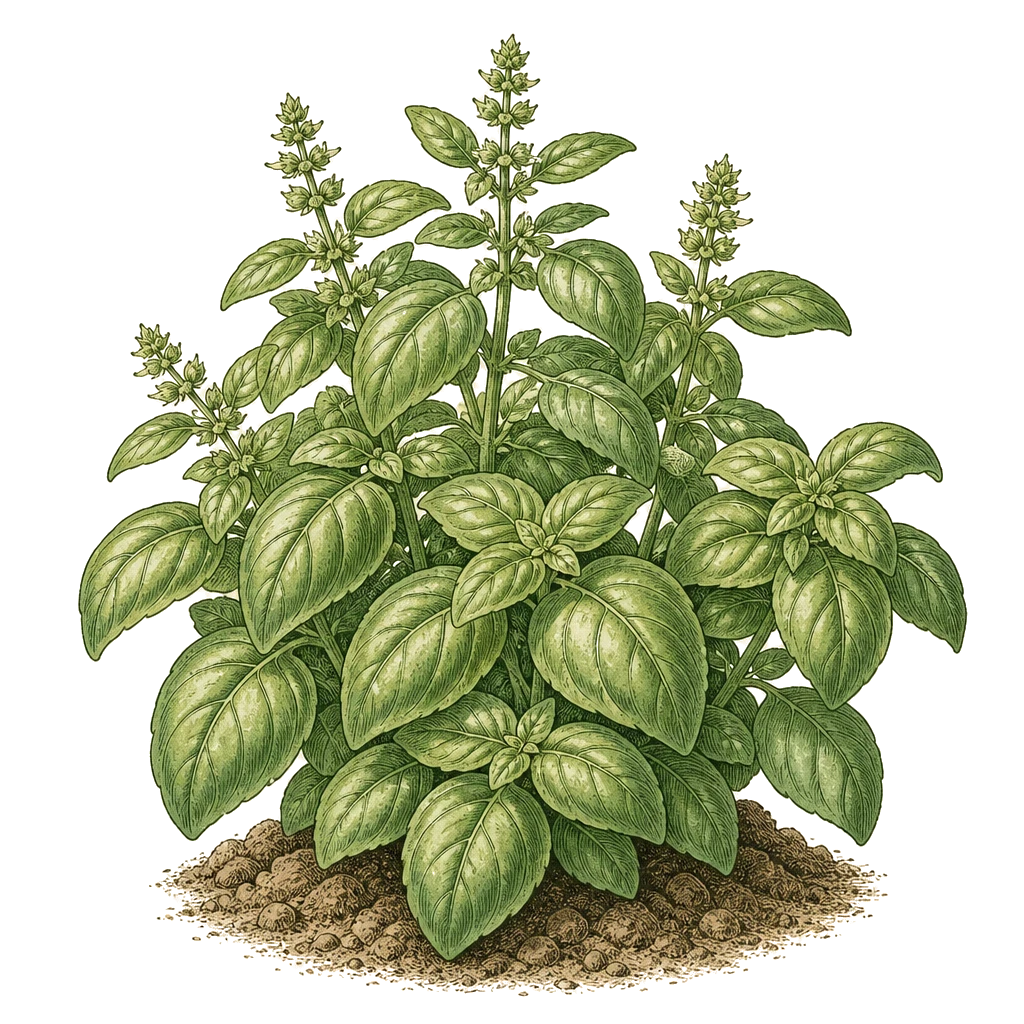
Basil is a tropical herb with no meaningful cold tolerance. Temperatures at or below 40°F cause acute cellular damage with leaves turning black within hours, and the affected tissue does not recover. Extended exposure to 50°F still causes visible stunting and discoloration, so 50°F nights, not frost warnings, are the floor for moving basil outdoors.
Bolting is the other half of the problem. When days lengthen and temperatures rise, basil switches from making leaves to making flowers and seed. Once flower buds form, the plant’s essential oils — the compounds responsible for flavor — concentrate in the reproductive structures rather than the leaves, which become noticeably more bitter. This shift is irreversible in any individual stem, but pinching removes the buds before they open, forcing the plant to branch and push new leafy growth instead.
What to do
Timing transplants. Wait until night temperatures are consistently above 50°F and soil temperature has reached at least 60°F before setting out transplants; check soil temperature with a soil thermometer rather than guessing from the air. Plan on transplanting roughly 2 weeks after your last frost date which is when those soil and air temperatures reliably arrive in most zones. Rushing by even a week is common and costly. Start seeds indoors 4–6 weeks before the last frost date at 70–85°F; germination takes 5–10 days. Harden them off first, giving them a week of increasing time outside so they adjust to sun and wind; the transplanting guide has the full process. If a cold night turns up after they go in, cover them: a row cover (light fabric over the bed) or a cold frame buys about 4–5°F, enough for a 45°F night but not a hard freeze.
Basil needs a minimum of 6–8 hours of direct sun per day. Soil pH of 6.0–7.5 suits it; well-drained, moderately fertile soil is ideal. Space plants 12 inches apart for adequate air circulation.
Pinching. Make the first cut once a plant carries six or more leaves, usually four to six weeks after transplanting. Waiting for flower buds throws away weeks of branching. Cut just above a leaf pair, never through the middle of a bare stem section. Each cut sends out two new branches from the nodes (where leaves join the stem) below it, and those branches do the same in turn. Never take a stem below its second leaf pair up from the base; the leaves left behind are what keep the plant growing. After that first cut, pinch or harvest every 7 days and take off flower buds as soon as you spot them at the stem tips. When you add basil in Arbor, it queues a weekly pinch task through the harvest season. Flowering equals bitter leaves and the reminder keeps that from sneaking up on you.
If a plant budded while you were away, cut those stalks back four leaf nodes down the stem, never below that second leaf pair; that shocks basil out of flower production, and the leaves below the cut are still worth eating, if less sweet. Once most stems are sending up flowers it is too late for that rescue so take what is there and lean on a younger succession plant.
Watering and fertilizing. Water at the base of the plant; wetting the foliage creates conditions for downy mildew. Established plants want water about every 4 days, closer to every 3 above 90°F, sooner in sand and later in clay; skip a round after half an inch of rain. Never let the soil dry out completely or stay waterlogged; basil has low drought tolerance. Basil is a light feeder, and over-fertilizing reduces essential oil concentration, which means less flavor. Work in about 3 pounds of 5-10-10 per 100 square feet before planting; if plants need more later, a quarter to half pound of calcium nitrate per 100 square feet about 2 months after planting is enough. Avoid heavy nitrogen applications. To scale that rate to your own bed, see fertilizing a vegetable garden.
Harvest and storage. Cut stems just above a leaf pair to trigger branching. When harvesting for continuous production, alternate among several plants so none is stripped at once. Fresh basil should never go in the refrigerator as temperatures at or below 40°F cause the same blackening as cold injury in the field, and a refrigerator sits right at that threshold. Store fresh-cut stems in a glass of water at room temperature, like a bouquet, for 2–3 days. For longer storage, freeze whole leaves in sealed bags with the air squeezed out, or chop and freeze in ice cube trays with water or olive oil.
Diseases. Downy mildew (Peronospora belbahrii) shows first as yellowing between leaf veins and gray fuzzy spore growth on the undersides of leaves. The most effective strategy is planting resistant varieties: Rutgers Devotion DMR, Rutgers Obsession DMR, and Prospera are bred to resist downy mildew, though resistant is not the same as immune. Avoid overhead irrigation and water in the morning so foliage dries quickly. If downy mildew appears on a susceptible variety mid-season, remove and discard the most heavily infected leaves immediately, stop all overhead watering, and harvest as much as possible before infection advances as the disease progresses rapidly in warm, humid weather.
Fusarium wilt (a soilborne pathogen) is the other common disease; plants wilt suddenly and show brown streaks on lower stems. There is no cure once plants are infected. Remove and destroy affected plants immediately and rotate basil away from that spot for at least 3 years.
Pests. Aphids occasionally colonize basil. A hard spray of water is usually enough to knock them off; insecticidal soap handles heavier infestations. For a full treatment protocol, see aphids on vegetables.
Zone and season notes
In zones 3–5, the basil window is short so transplant after the last frost (often late May or early June) and plan on 8–10 weeks of harvest before fall frost arrives. Succession planting every 2 weeks through early summer gives you replacement transplants if a late cold snap catches the first round.
In zones 6–8, a mid-May transplant date is typical for most of the Mid-Atlantic, Midwest, and Pacific Northwest. Two or three succession plantings through June extend the harvest season well into September with consistent pinching.
Water demand climbs above 90°F in any climate, arid or humid, so check soil moisture more often through the hottest weeks. Downy mildew needs warmth and humidity together, so it runs worst through humid coastal summers, where DMR varieties earn their place; an arid summer of the same heat sees far less disease. Florida gardeners in zones 9–11 often skip summer basil entirely — growing it during the fall-to-spring cool season when temperatures are more favorable.
Basil can persist as a tender perennial only where no winter night drops below 40°F. Average winter temperature is the wrong test, and so is a zone number: one clear night below 40°F ends it. Watch your own nighttime lows if you are trying to carry a plant through.
Sources
- University of Minnesota Extension — Growing basil in home gardens
- Illinois Extension — Basil
- Iowa State University Extension — Growing Basil in the Home Garden
- Clemson HGIC — Basil
- Utah State University Extension — How to Grow Basil in Your Garden
- University of Maryland Extension — Growing Basil in the Home Garden
- WVU Extension — Growing Basil in West Virginia
- Rutgers NJAES — Ultra-Niche Crops Series: Fresh-Market Basil (FS1279)
- University of Maryland Extension — Fusarium Wilt in Basil
- University of Minnesota Extension — Basil Downy Mildew
- Rutgers Plant & Pest Advisory — Options for Controlling Basil Downy Mildew
- UC ANR / UC Master Gardeners — Maximizing Your Basil Harvest
- Penn State Extension — Basil, A Summer Favorite
- NDSU Agriculture Extension — Harvesting Herbs for Healthy Eating
- University of Arizona Cooperative Extension — Basil