Row Cover, Low Tunnels, and Cold Frames Compared
Row cover, low tunnels, and cold frames buy different amounts of protection, and picking the wrong one for the job wastes money and still loses the crop. Lightweight row cover trades almost no light for about 2°F of frost protection; heavyweight fabric trades a lot of light for up to 8°F. Low tunnels are the same fabric lifted onto hoops: the same degrees of protection, with room for the crop to grow underneath. Cold frames go further, typically stretching the growing season by 2 to 4 weeks at each end. All three fail the same way: left closed on a sunny day, they cook the crop instead of protecting it.
How it works
Row cover fabric comes in three weight grades, and the tradeoff is consistent across all of them: more frost protection costs more light. Lightweight fabric (0.45 oz per square yard) lets through 90–95% of available light and holds in about 2°F of frost protection — thin enough to work mainly as an insect barrier, and light enough to leave on crops like beets, beans, and salad greens straight through harvest. Medium-weight fabric (0.5–1.0 oz per square yard) transmits 70–85% of light for 4–6°F of protection, the middle ground for spring, fall, and overwintering crops. Heavyweight fabric (1.5–2.2 oz per square yard) blocks half the light or more, down to 30–50% transmittance, in exchange for up to 8°F of frost protection, and it’s meant for overwintering rather than crops that still need to grow and fruit under it. Heavyweight cover can also raise the daytime air temperature underneath it by 10°F or more.
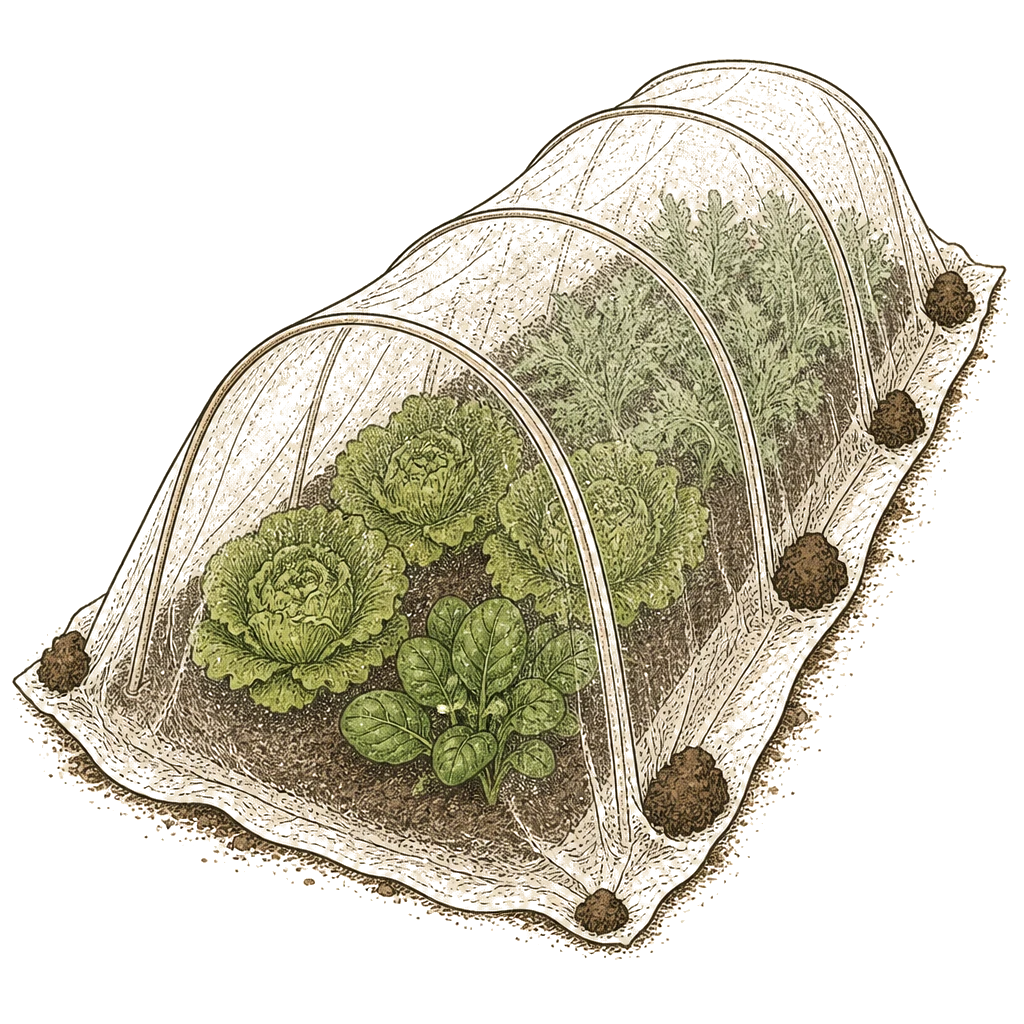
Hoops change the geometry, not the fabric: row cover or clear plastic stretched over them rides above the crop instead of resting on top of it the way floating row cover does. Hoops run 15 to 30 inches high, spaced every 2 to 4 feet, with 9-gauge wire or metal or plastic pipe both working fine for the frame. Raising the material off the leaves gives the crop room to grow. Draped or hooped, row cover gives roughly 4–5°F of protection over no cover at all.
Cold frames go furthest because they’re a sealed box, not draped fabric. There’s no single standard size, but around 4 to 5 feet wide is about as far as a person can reach across comfortably, and a well-built frame extends the growing season by about 2 to 4 weeks in both fall and spring.
What to do
Match the row cover weight to the job. Reach for lightweight fabric to keep insects off leafy crops or trim a couple of degrees off a marginal frost, since it can stay on right through harvest. Step up to medium or heavyweight fabric for a real spring or fall cold snap, or for overwintering crops that need to survive hard freezes rather than keep growing. Install cover soon after planting, and anchor the edges completely with sod pins, boards, bricks, sandbags, rocks, or soil — for insect exclusion, bury the edges rather than just weighting them, or pests walk in underneath. Leave slack for growth. At the end of the season, take covers off gradually and pick a cloudy day for the final removal so the crop isn’t shocked by sudden full sun after weeks of shade. Expect the fabric to last 1 to 3 years depending on weight and weather exposure.
Building a low tunnel is mostly a matter of setting hoops 2 to 4 feet apart at 15 to 30 inches high and draping row cover or plastic over the top, anchored the same way as floating cover. Building a cold frame is more of a small construction project: keep the frame no more than 3 feet deep and build the back wall about 6 inches taller than the front, which slopes the glazing 10 to 15 degrees toward the sun. Glazing can be an old storm window, sash, or shower door, or clear rigid plastic or fiberglass panels; the frame itself can be built from wood, cinderblock, brick, poured concrete, plastic lumber, or straw bales.
None of that matters if the box or tunnel doesn’t get vented. Vent ahead of the heat, not after it. One concrete starting rule: prop the sash open once the air inside a cold frame climbs above 85°F, and close it again before sunset so the day’s stored heat carries the crop through the night. Treat that number as a trigger to check, not a substitute for judging the actual conditions — a warm, sunny, still day calls for venting even before the thermometer says so, and a thermometer inside the frame is worth more than a fixed clock.
A floating cover or a low tunnel has no sash to prop, so venting there means opening the cover itself: lift it off the crop for the afternoon, or cut long slits along the top of a tunnel. Cool-season crops run best between 50 and 80°F, so that 85°F trigger already fits them; flowering tomatoes and peppers are fussier, with blossom drop starting between the mid-80s and 90°F under cover.
If you log a bed as covered in Arbor, it puts a check-back task on your list for the next sunny forecast day, so venting doesn’t get forgotten once the frame or tunnel is out of daily sight.
Zone and season notes
How these tools work doesn’t change by zone. Where they earn their keep does: cold-winter zones stretching a short season at both ends get the most out of a few extra weeks in spring and fall. The venting failure runs the other way: clear, sunny days in late winter and early spring are when a frame or tunnel overheats, which makes a mild, bright climate as much of a venting problem as a cold one.
A cold frame also does double duty as a hardening-off space in spring: hardy cool-season crops like lettuce, spinach, and radishes can go in two to four weeks ahead of when you’d otherwise sow them outside, and the same box hardens off warm-season transplants like tomatoes or peppers before they go out after last frost. For the planning side of that timing — when a zone’s actual frost dates fall, and how far row cover or a cold frame can reasonably push them — see when to plant vegetables and the fall garden planting guide for counting backward from first frost.
Sources
- University of Maryland Extension — Row Covers
- Wisconsin Horticulture (UW–Madison Division of Extension) — Floating Row Cover
- NC State Extension — Extension Gardener Handbook, Appendix E — Season Extenders and Greenhouses
- Iowa State University Extension and Outreach — All About Cold Frames
- South Dakota State University Extension — Cold Frames